How to prevent and control tipburn in Welsh onions when the leaf tips turn white and dry out
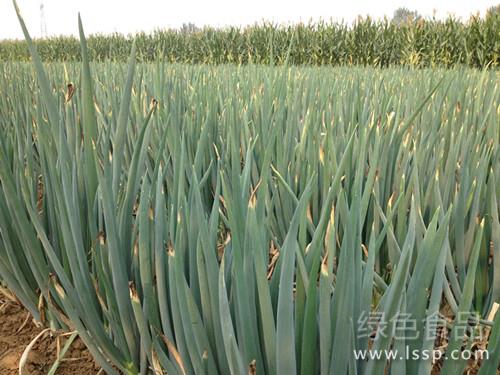
Tipburn in Welsh onions
Tipburn caused by acidic soil:Neutral soil with a pH of 7 to 7.4 is most suitable for growing Welsh onions. When little organic fertilizer is applied and large amounts of ammonium sulfate and superphosphate are used, the soil becomes acidified, causing the onion leaves to grow slowly, become thin and weak, and the outer leaves to turn yellow and wither. Control measures: apply enough decomposed organic fertilizer per mu and 150 kg of calcium oxide.
Tipburn caused by drought: Failure to pay attention to watering and dry soil leave Welsh onions short of water, which easily causes tipburn. Control measures: water at the right time and in the right amount according to the different water needs of Welsh onions at different growth stages. Seedling stage: control water appropriately, do not water unless the soil is dry, and water lightly once every 15 to 20 days; vegetative growth stage: water promptly along with topdressing and earthing up to ensure sufficient water, keeping field capacity at 70% to 80%; harvest stage: control watering 10 to 15 days before harvest, keeping field capacity at 60% to 70%.
Tipburn caused by a lack of trace elements:Calcium deficiency causes the tips of the heart leaves to turn yellow, and magnesium deficiency causes the tips of the outer leaves to turn yellow. Control measures: apply trace element fertilizer by foliar feeding to make up the shortfall, such as spraying with 0.1% to 0.3% calcium nitrate or 0.1% magnesium chloride.
Tipburn caused by high temperatures and freezing injury:The temperature range for Welsh onion growth is 7°C to 35°C. Above 35°C, the leaf tips dry up; below 7°C, the leaf tips are the first to be frozen and turn white. Control measures: for Welsh onions grown in the open field, pay attention to watering to lower the temperature; for those grown in greenhouses, strengthen ventilation to prevent high temperatures above 30°C, and strengthen insulation so that the minimum temperature does not fall below 7°C.
Tipburn caused by toxic gases:Applying ammonium sulfate or ammonium chloride as a topdressing in an enclosed environment causes ammonia damage, and soil acidification causes nitrite gas damage. Ammonia wilts the leaf tips, which gradually turn brown; nitrite gas turns the leaf tips white and kills them. Control measures: first, ventilate; second, apply more organic fertilizer, and do not apply ammonium carbonate as a topdressing when the environment is enclosed and not ventilated; third, use Tianyi EM stock solution as a root drench or spray to relieve the damage, with the specific method as follows: drench the roots once with a 500-fold dilution, and spray with a 1000-fold dilution once every 7 days for 2 consecutive sprays.
Tipburn caused by phytotoxicity:Excessively high pesticide concentrations turn Welsh onion leaf tips white and dry. Control measures: use a reasonable pesticide solution concentration, spray a 500-fold dilution of 0.05% nucleotide AS (Lüfeng 95) to relieve phytotoxicity, or spray a 500- to 800-fold dilution of Tianyi EM stock solution in the early morning or evening once every 7 days for 2 to 3 consecutive sprays.