Garlic virus disease causes leaves to curl and the heart leaf to struggle to emerge; how can it be prevented and controlled?
Garlic virus disease, also known as mosaic disease. Generally, 100% of garlic in the field carries the disease, and it is one of the main causes of garlic degeneration. Because garlic reproduces asexually, its reproduction coefficient is low, prevention and control are relatively difficult, and losses are considerable.
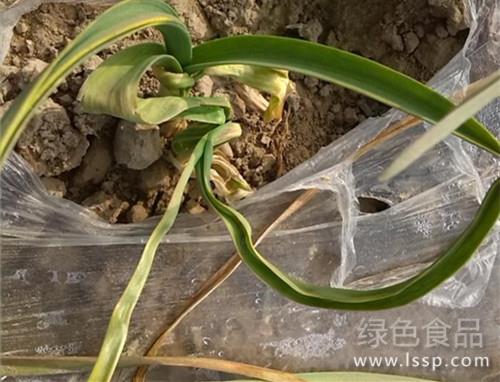
Garlic virus disease
Symptoms: Symptoms can appear from the seedling stage to the mature plant stage of garlic. Typical symptoms: obvious yellow chlorotic stripes of varying lengths appear on the leaves, diseased plants show varying degrees of dwarfing, grow thin and weak, and the waxy layer on the leaves decreases or disappears, losing their gloss. The leaves of severely diseased plants are semi-curled, and some upper and lower leaves twist together and curl into a tube shape, with the heart leaf unable to emerge. Severely diseased plants cannot bolt, and even if they bolt, the garlic scapes also show obvious chlorotic spots. The root system of diseased plants develops poorly, with short and few roots, and the garlic bulbs are obviously smaller.
Transmission routes and conditions for disease development: Garlic virus disease is mainly transmitted through virus-carrying garlic cloves, and aphids, nematodes, etc. can also transmit the virus, as can mechanical rubbing. Because garlic uses bulbs as planting material, the virus-carrying rate is 100%, so after sowing virus-carrying garlic cloves, the plants are already infected after emergence, with only differences in severity. As a result, there is no garlic in the field free from virus infection, causing garlic bulbs to degenerate severely and become smaller.
Prevention and control methods:
1. Strict seed selection: Choose garlic with large bulbs, large and uniform cloves, firm cloves, white color, and freshness for seed. Where conditions permit, virus-free garlic seed can be selected.
2. Agricultural control: Apply sufficient organic fertilizer, with barnyard manure and cake fertilizer being preferable, and increase the application of phosphorus and potassium fertilizer. Generally, apply 5000-6000 kg of high-quality decomposed barnyard manure and 70-100 kg of soybean cake or cottonseed cake per mu as base fertilizer, and also apply topdressing during the growing period. The first topdressing is around Qingming, applying 25-30 kg of ammonium sulfate per mu. When the garlic scapes are emerging, apply the second topdressing, applying 25-30 kg of nitrogen, phosphorus, and potassium compound fertilizer per mu. Formula fertilizer and foliar fertilizer are recommended. Water reasonably, implement plastic film mulching, promote growth, avoid premature aging of garlic, and improve garlic disease resistance.
3. Chemical control: In the early stage of garlic disease onset, choose 20% Virus Nemesis 400-fold solution, or 20% Virus A wettable powder 500-fold solution, or 1.5% Zhibingling emulsifiable concentrate 1000-fold solution, or Antiviral Agent No. 1 250-300-fold solution for spraying, once every 10 days, spraying 2-3 times consecutively.