How to Handle Winter Adverse Weather for Greenhouse Vegetables
Emergency Measures for Greenhouse Vegetables
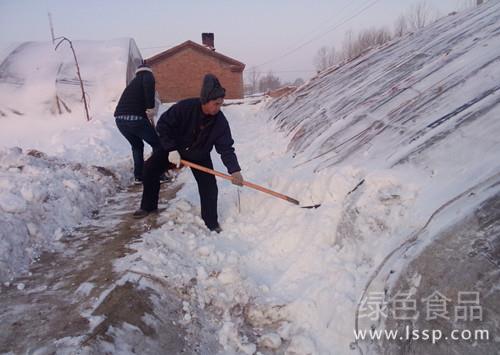
I. Snowy Days:After the snow stops, roll up the straw curtains promptly and immediately sweep away the snow on the greenhouse. For parts of the greenhouse slope that are difficult to clear, gently scrape downward with a smooth wooden stick, trying not to tear the greenhouse film. If it snows at night, the snow on the straw curtains must be removed promptly; the straw curtains should be wrapped with plastic film in advance to prevent them from absorbing water, which would make the greenhouse structure bear too much weight and cause the arch frames to twist or even collapse.
II. Continuous Overcast Days:These should be handled differently. If continuous overcast days occur, as long as the temperature is not too low, uncover the straw curtains. If there is brief sunshine, the greenhouse temperature will rise. Hanging a reflective curtain on the rear wall inside the greenhouse can also help increase light and raise temperature on overcast days. When there are many overcast days in winter, plastic mulch should be laid early, which can raise soil temperature and reduce low-temperature freezing damage. In winter, the temperature inside the greenhouse should be above 12°C; when the temperature is too low, measures such as electric heating and coal stove heating can be used.
III. Windy Days:When the greenhouse film bulges, immediately tighten the film-pressing lines or lay part of the straw curtains down to press on the middle of the front roof of the greenhouse; it is best to lay a layer of straw curtains horizontally across the front bottom edge of the greenhouse, then press them firmly with stones.
IV. After Long Overcast Then Sudden Clearing:After long periods of overcast and foggy weather, once it clears, the transpiration of vegetables strengthens, root absorption cannot keep up, and a large number of seedlings die. After it clears, the temperature rises quickly and the seedlings will wilt sharply. Prevention methods: First, pay attention to covering with straw curtains to prevent seedling flash. From around 10 a.m., watch for changes in the seedlings and take measures such as moderately covering with straw curtains and spraying clean water (or foliar fertilizer) inside the greenhouse. Second, after it clears, delay watering as much as possible; water only after the root system has recovered its vitality, otherwise it is easy to cause root rot and seedling death. If watering and topdressing are needed, water lightly and apply quick-soluble fertilizer with the water, with a low concentration. Third, after it clears, use root-promoting agents to drench the roots, and spray multi-element micronutrient fertilizer on the leaves to make up for insufficient root absorption.
V. Pests and Diseases:Common ones include tomatoes, celery, cucumbers, rapeseed, etc.; tomatoes in particular are prone to late blight and gray mold. The reason is long-term low temperature, which weakens vegetable growth vigor and reduces resistance, making pests and diseases more likely to occur. For gray mold, spray with 50% iprodione, Shimeite, or procymidone at 600 times dilution, once every 7-10 days. To prevent diseases, also spray foliar applications of plant growth regulators such as Lvjian and Huafu at 1000 times dilution to enhance the cold resistance and disease resistance of vegetables. If overcast weather occurs, use smoke agents or dusts as much as possible to prevent diseases, so as to reduce humidity inside the greenhouse and avoid the occurrence of diseases.