Control methods for pepper leaf, fruit and stem scab lesions in greenhouses
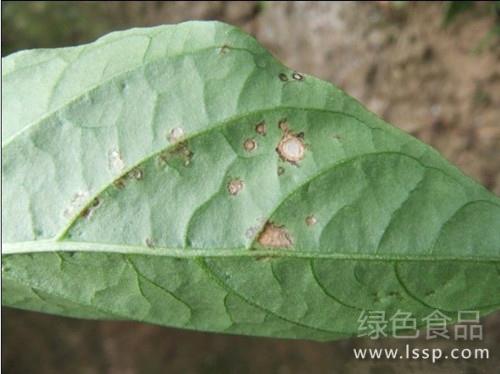
Pepper scab
I. Damage symptoms:
It occurs on pepper seedlings, leaves, stems, fruits and other parts, with leaves being commonly affected. When seedlings are affected, water-soaked silvery-white spots appear on the cotyledons and gradually turn into pale black sunken lesions; at the adult plant stage, diseased leaves first develop water-soaked yellow-green spots, which later expand into irregular shapes with dark brown edges, slightly raised, with a lighter center, slightly sunken, and a rough surface resembling scab. Several lesions joining together form irregular large spots. On severely affected leaves, the leaf margins and leaf tips become dry and cracked, and eventually fall off. If lesions develop along the veins, they often cause leaf deformity.
When stems or fruit stalks are affected, water-soaked irregular streaks first appear, then turn dark brown, raised, longitudinally cracked, and scab-like.
When fruits are affected, black or dark brown raised small spots or blister-like spots first appear. The lesion edges are water-soaked and slightly raised. The lesions are round or oblong dark brown scab-like spots. Some lesion edges have cracks, and when moist, bacterial ooze exudes from the center.
II. Pathogen and transmission routes:
Pepper scab is caused by bacteria of the genus Xanthomonas. The pathogen can overwinter on the seed surface, becoming a long-distance source of infection, and can also overwinter in the soil with diseased plant residues. Field transmission mainly relies on irrigation and agricultural operations. The bacterium can only invade through plant wounds and openings. After the plant becomes diseased, bacterial ooze exudes from the diseased parts and can be spread repeatedly.
III. Disease conditions:
High temperature and humidity are the main conditions that induce pepper scab, so the disease is severe in greenhouses. The minimum temperature for disease development is 5°C, and the optimum temperature is 27-30°C. Under high temperature and high humidity, the lesions expand rapidly, pepper growth is poor, the field is closed and shaded, and the disease is severe.
IV. Control methods:
1. Seed treatment. Pepper seeds can be soaked in warm water at 55°C for 10 minutes, or soaked in agricultural streptomycin or Xinzhiycomycin at 1000 times for 30 minutes, or soaked in 1% copper sulfate for 5 minutes, then washed with water and germinated. In addition, they can also be soaked in 1‰ potassium permanganate for 15 minutes, but they must be washed clean before germination.
2. Crop rotation. Carry out 2-3 years of rotation with hosts other than pepper, sweet pepper and tomato.
3. Strengthen management. After pepper planting, loosen the soil and topdress fertilizer in time to promote root development. In greenhouse cultivation, pay special attention to ventilation, cooling and dehumidification.
4. Chemical control. Optional agents: 1:1:200 Bordeaux mixture, streptomycin or Xinzhiycomycin at 4000 times, 60% phosethyl-Al (DTM) wettable powder at 500 times, 77% Kocide (copper hydroxide) wettable powder at 400-500 times for spraying. Choose any one of the above agents, alternate the agents, spray once every 7-10 days, and spray 2-3 times continuously depending on the disease severity.
5. Diseased plants, diseased leaves and diseased peppers should be collected in time and taken outside the field for centralized destruction.