Why do tomato leaves curl upward, become stiff and brittle? Causes of leaf curl disease and how to prevent and treat it
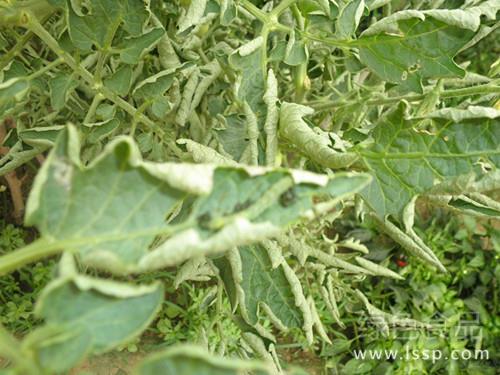
Tomato leaf curl disease
High-temperature leaf curl:When tomatoes are exposed to temperatures above 30°C, growth slows, photorespiration increases, and nutrient accumulation is affected. Under prolonged high temperatures above 35°C, leaf transpiration accelerates, causing the rate at which roots transport water to fall behind the rate of leaf transpiration, resulting in dehydration-induced upward leaf curling on the leaf surface. Treatment measures: for tomatoes grown under protected cultivation, add shade nets in time, widen the greenhouse vents, and be careful not to remove the insect-proof nets. Spraying 6000-fold diluted Bihu (Brassinolide) solution can alleviate leaf curl disease.
Low-temperature leaf curl:The optimum temperature for tomato growth is around 25°C during the day and 16°C-18°C at night, and the critical low temperature at which growth stops is 10°C. When it stays below 10°C, the mesophyll cells suffer cold damage, and the leaves bend downward until the cells freeze and turn white. Treatment measures: for tomatoes grown under protected cultivation in cold seasons, when the greenhouse temperature is insufficient to guarantee the requirements for tomato growth, it is recommended to add heating wires for warming or temporarily increase stove fire to raise the temperature. At the same time, spray 7500-fold diluted Bihu (Brassinolide) solution, and carry out 1-2 foliar fertilizer sprays combined with water spraying. When the leaves turn yellow, foliar fertilizers such as Yelübao, Gumilü, and Ruipeilü 1000-fold solution can be sprayed for conditioning.
Excessive fertilization burning and leaf curl:The fertilization plan is formulated according to the target yield of tomatoes, and the amount applied per flush should be determined by the current number of fruit clusters. Some vegetable growers always assume that more fertilizer means higher yield, not realizing that excessive fertilizer causes localized fertilizer concentration in the soil to become too high, resulting in root burn and leaf-edge scorch-spot leaf curl. Treatment measures: fertilize reasonably, and control the amount when applying water-soluble flush fertilizers.
Viral infection leaf curl:Tomato plants infected with fern-leaf-type viral disease first show varying degrees of stunting, and all or part of the leaves curl upward from top to bottom. Treatment measures: foliar spray with 25% Actara water-dispersible granules 2500-5000-fold solution, 24.7% Alika microcapsule suspension 3000-fold solution, 20% Virus A wettable powder 500-fold solution, 1.5% Zhi Bing Ling emulsifiable concentrate 1000-fold solution, etc.
Herbicide phytotoxicity leaf curl:When pre-emergence herbicides are applied to nearby corn fields, they easily drift with airflow and cause phytotoxicity to tomato plants, resulting in tomato leaves curling upward, becoming stiff and brittle. Treatment measures: for mild cases, spray 5000-fold diluted Bihu (Brassinolide) solution to promote the curled leaves to unfold. At the same time, strengthen intertillage and fertilization to promote tomato plant growth, and the rescue effect will be better.