Proper Fertilization Promotes High Yield: Garlic's Fertilizer Requirements and Fertilization Methods
Garlic roots grow from the base of the shortened stem and are fibrous roots of a filamentous type. Garlic likes moisture and fertilizer and is cold-tolerant, with broad adaptability to soil. More roots develop on the back side of the clove and fewer on the belly side, and the main root mass is concentrated within the 5-25 cm soil layer, with a horizontal spread radius of 15 cm. Loamy soil and sandy loam soil with deep soil layers, loose structure, and good drainage are most suitable. However, garlic is highly prone to continuous cropping obstacles, which can be alleviated by rotating with crops such as corn and rice.
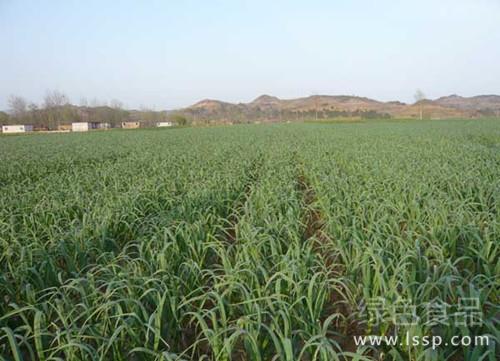
Garlic
I. Garlic's fertilizer requirements:
1. Nitrogen: uptake is low during the overwintering period, then gradually rises, reaching a peak at the bulb enlargement stage; before the differentiation stage, nitrogen uptake accounts for 30% of total uptake, so meeting garlic's nitrogen demand in the mid-to-late growth period can increase garlic yield and grade.
2. Phosphorus: phosphorus uptake is low before overwintering and becomes even lower after entering the overwintering period. From the green-up stage onward, phosphorus uptake gradually increases, peaking at the differentiation and bolting stage. Because garlic's vegetative growth and reproductive growth proceed simultaneously, phosphorus uptake is high and urgent, making this the intensive phosphorus nutrition period for garlic, accounting for 52.1% of total phosphorus.
3. Potassium: garlic's potassium uptake has two peak periods. In the pre-winter seedling stage, potassium uptake accounts for 10.5% of total potassium, and it is low during the overwintering period. Entering the green-up stage, potassium uptake shows its first peak, accounting for 26.7% of the total, nearly 4 times that of the seedling stage; the bulb enlargement stage is the second peak, accounting for about 45% of the total.
II. Garlic fertilization techniques:
1. Fertilization principles: scientific and rational fertilization should be carried out according to soil fertility and the needs of garlic at different growth stages. Follow the principle of "light early, heavy middle, supplementary late," both preventing excessive early growth and avoiding premature senescence later.
2. Land preparation and fertilization: the garlic planting plot needs deep plowing and fine harrowing to enhance soil permeability, favor soil microbial activity and nutrient transformation, improve soil storage capacity, and benefit root development and bulb enlargement. After the previous crop is harvested, plow and sun the soil clods in time, with a plowing depth of 20-25 cm.
Because plastic film mulching is used, topdressing is not suitable during the garlic growing period. Therefore, before sowing, sufficient base fertilizer should be applied at one time in combination with land preparation. Per mu, apply 2500-3000 kg of farmyard manure, 40-75 kg of chlorine-based compound fertilizer, and 1.5-2 kg each of ferrous sulfate, manganese sulfate, borax, zinc sulfate, and copper sulfate, broadcast on the soil clods.
3. Heavy application of jointing fertilizer: under normal weather conditions, for garlic at the green-up stage, field management is generally not needed, to avoid bacterial soft rot caused by a sudden drop in ground temperature from watering too early, which would affect garlic growth; therefore, the first topdressing should be carried out at the jointing stage, with 20-25 kg of nitro compound fertilizer applied per mu. Apply the second fertilizer after an interval of 15-20 days, at about 20 kg per mu.
4. Skillful application of differentiation and bolting fertilizer: during garlic's differentiation and bolting stage, vegetative growth and reproductive growth proceed simultaneously, and phosphorus demand is strong. This is the most critical topdressing of garlic's entire life. Wait until the garlic scape emerges (shows its tail), then apply 15-20 kg per mu of high-phosphorus, high-potassium compound fertilizer, dissolving it first and then flushing it on.
5. Timing of foliar topdressing: it should be done before 11 a.m. or after 4 p.m. on sunny days. Types of spray fertilizer: choose 2 kg of ordinary calcium superphosphate or 1 kg of sulfur-based compound fertilizer, soak in 50 kg of water for 12 hours, take the clear liquid and spray 1 mu; a 0.2%-0.4% potassium dihydrogen phosphate solution and 0.15% manganese sulfate, 0.5% borax, 0.2% zinc sulfate, and 0.15% copper sulfate solutions can also be used. In the mid-to-late growth period of garlic, according to growth vigor and appearance, foliar spraying can be carried out 1-2 times, once every 7-10 days.