Kiwifruit chlorosis causes leaves to be small, yellow, and thin - how to prevent and control it
Kiwifruit yellow leaf disease, also known as chlorosis, affects diseased plants so that, apart from the veins remaining pale green, the rest of the leaf turns yellow and loses its green color, the leaves are small and thin, and the tree vigor is weak. It mostly occurs on shoot-tip leaves and new leaves produced in spring.
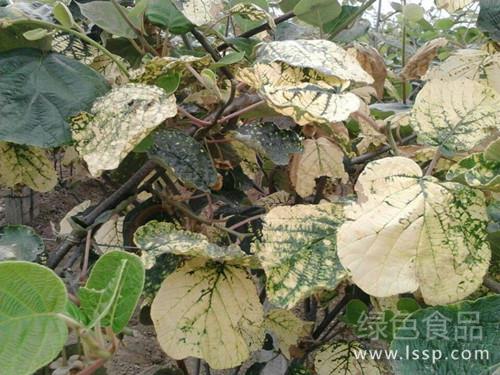
Kiwifruit chlorosis
Causes: too much water in the orchard, which damages the root system through waterlogging; deficiency of elements such as iron or molybdenum; and root rot or too much fertilizer, or unfermented fertilizer, damaging the root system, leading to physiological nutrient deficiency in kiwifruit and causing chlorosis.
Prevention and control measures: 1) Balanced fertilization. Apply nitrogen, phosphorus, and potassium together, and apply major elements together with trace elements. In alkaline soil, pay attention to increasing the application of organic fertilizer. For trees in full bearing period, apply 4000-5000 kg of decomposed organic fertilizer per mu each year, combined with deep plowing, to improve the soil. Plant clover in the large rows and cover the small rows with straw. Increase the soil organic matter content to more than 2%-3%.
2) Control yield and improve tree vigor. Strictly thin flowers and fruits, control yield, and for trees in full bearing period the yield per mu should preferably be 2000-2500 kg. Strictly prevent excessive load to maintain strong tree vigor.
3) Irrigate and drain at the proper time. Change flood irrigation to small-plot separate irrigation, avoid excessive irrigation, and guard against water accumulation. In years with more rain, strengthen intertillage; during continuous rainy weather, drain water promptly, and where conditions permit, use seepage irrigation or drip irrigation. For more severely affected trees, one week after the weather clears, dig several pits 25 cm deep around the roots of the diseased tree (depending on the vigor of the plant), then irrigate with 50 times diluted ferrous sulfate; two times will be enough.
4) Adjust soil pH. In alkaline soil with a pH of 7.5 or above, it is recommended to apply 1 kg of sulfur powder or 8% acetic acid solution per plant to appropriately lower the pH at the root zone.
5) Apply topdressing reasonably. In the early growth stage of kiwifruit each year, chemical fertilizer application should mainly be ammonium nitrogen fertilizers such as ammonium sulfate or urea, with less use of nitrate nitrogen fertilizers and ammonium bicarbonate. When applying iron fertilizer to the soil, it should be mixed with decomposed organic fertilizer or humus fertilizer.