Strawberry virus disease causes leaf crinkling and deformity and plant stunting; how can it be prevented and controlled?
Typical symptoms of strawberry virus disease: mosaic, yellowing, necrosis, deformity, etc. The most common is mosaic. When a strawberry plant shows symptoms, the leaf veins become slightly transparent, the leaf color varies in shade, forming a mottled mosaic; in severe cases, the leaves become uneven, crinkled and deformed. At the same time, the diseased plant grows slowly and is severely stunted, and when the fruit is infected it also becomes deformed. Moreover, it is also very common for several symptoms such as mosaic, yellowing, necrosis and deformity to occur on a single plant.
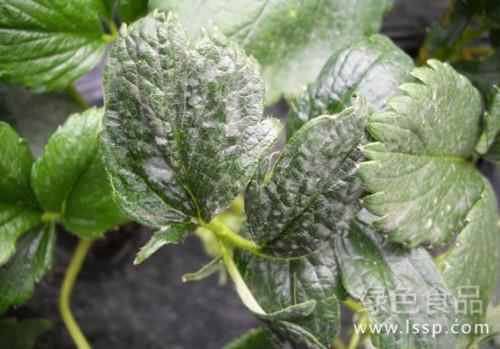
Strawberry virus disease
I. Main causes:
The pathogen of strawberry virus disease cannot overwinter on diseased plant residues; it can only overwinter on strawberries that survive and are planted in winter, on perennial weeds, and on strawberry stock plants. The following year it spreads through aphids, contact and wounds, and is transmitted through wounds on strawberry plants caused by pruning and shoot thinning. Aphid feeding is also one of the main transmission routes. High temperature and drought are suitable for the occurrence and proliferation of strawberry virus disease. Strawberry fields with extensive management and overgrown weeds suffer more severe occurrence.
II. Prevention and control techniques:
1. Use resistant varieties: Different strawberry varieties have different resistance to virus disease. During cultivation, to reduce the occurrence of virus disease or slow its damage, varieties with strong resistance should be cultivated. Varieties such as Japan No. 99, America No. 3, Nyoho, Dasai and Jingxiang have relatively strong resistance to virus disease.
2. Apply more organic fertilizer and strengthen intertillage management: The level of soil fertility directly affects whether strawberry plants grow vigorously. Therefore, whether in open-field or protected cultivation, sufficient organic fertilizer should be applied to provide a good growing environment for strawberry plants. At the same time, intertillage and weeding should be strengthened in time, and aphids should be eliminated in time to reduce the transmission routes of strawberry virus disease.
3. Virus-free treatment of seedlings: Use shoot-tip virus-free biochemical tissue culture seedlings, and cultivate virus-free strawberry seedlings.
4. Control transmission routes: Aphids are one of the important transmission vectors of strawberry virus disease. When interplanting thick-skinned melon in greenhouse strawberries, attention should be paid to controlling aphids. First, taking advantage of aphids' avoidance behavior, set up yellow sticky boards to trap aphids and silver-gray film to repel aphids. After autumn transplanting, in addition to appropriately delaying sowing to avoid the aphid migration period, aphids, whiteflies and thrips should be eliminated in time during seedling raising. Strengthen the configuration of insect-proof nets in strawberry greenhouses. Before strawberry seedlings are transplanted, drenching with 25% Actara water-dispersible granules will have a long-lasting effect of more than 30 days against aphids and whiteflies. 2~3 days before transplanting, spray the seedlings with 25% Actara water-dispersible granules at 1500~2000 times dilution; in addition to spraying the leaves, it should also penetrate into the soil. Spray about 2 kg of solution per sq m of seedbed.
5. Chemical control: Spray with 25% Actara water-dispersible granules at 2500~5000 times dilution, or 10% imidacloprid wettable powder at 1000 times dilution, or 10% Kangshiding wettable powder at 1000 times dilution, or 2.5% green kung fu aqueous solution at 1500 times dilution, or 1.5% zhibingling emulsifiable concentrate at 1000 times dilution, or 30% bingduxing wettable powder at 500 times dilution; all of these can control strawberry virus disease to a certain extent.