The "Five-Character Formula" for Renovating Low-Yield Walnut Groves by Replacement, Thinning, Cultivation, Fertilization and Pruning
To achieve quality and high yields from low-yield walnut groves, mountain low-yield walnut groves must be renovated in a timely manner. The main technical measures adopted are summarized as the "Five-Character Formula":
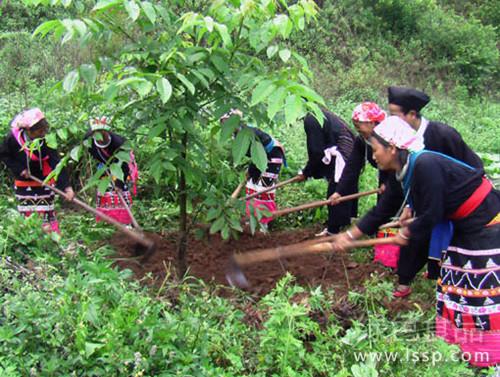
Renovating low-yield walnut groves
1. Replacement, that is, top-grafting with superior cultivars.
For young low-yield walnut trees, the multi-leader bark-insertion tongue grafting method is used for top-grafting superior cultivars. The best time for top-grafting is from when the rootstock bark slips to the bud-break stage, and the survival rate can reach 95%.
2. Thinning, that is, manual thinning of male flowers.
Before the walnut male flowers begin to swell or when they just begin to swell, 80% of the male flowers are removed manually, which can increase yield by about 15%. The method is: use a wooden hook to pull down the branches or climb the tree to pick off the male flower buds, keeping only about 20% of the male flower buds on the top and outer branches of the canopy to meet pollination needs.
3. Cultivation, that is, tilling and mulching with expanded tree basins.
In early spring or late autumn each year, tilling and mulching with expanded tree basins is carried out around the walnut trees to loosen the soil, control weeds, and store water and conserve fertilizer. After tilling and mulching with expanded tree basins, the walnut trees bear fruit earlier and more abundantly, new shoot growth increases by 1.1 times, leaf fall is delayed by 8—13 days, and yield increases by 30%. Tilling and mulching with expanded tree basins is done to a depth of 20—40cm, combined with building reverse-slope terraces, digging fish-scale pits, and building water-storage basins.
4. Fertilization, that is, scientific fertilization.
Fertilization is carried out together with tilling and mulching with expanded tree basins, and light-weight farmyard manure is mainly used for ease of transport. About 100 kg of farmyard manure is applied per tree per year. Before flowering and during the fruit-swelling stage, 1 kg of urea and 1.5 kg of phosphate fertilizer are applied as top-dressing respectively. In addition, foliar top-dressing is also carried out on walnut trees that are easy to manage. The method is: spray 0.3% urea plus 0.2% boric acid at the flowering stage, and spray 0.3% monopotassium phosphate during the fruit-swelling stage.
5. Pruning, that is, rational pruning.
Walnut trees suffer rather serious "bleeding". To avoid the "bleeding" phenomenon, pruning is carried out in spring and autumn each year. Spring pruning is carried out from after leaf expansion to the young fruit-swelling stage; autumn pruning is carried out from after walnut harvest to before leaf fall. For young trees in the initial fruiting stage, pruning mainly adjusts the vigor of the scaffold branches at all levels so that the canopy is well rounded; for large trees in the full fruiting stage, pruning mainly removes dead, overlapping, water-sprout, and pest- and disease-damaged branches, raises the fruiting angle, improves ventilation and light penetration, and achieves the effect of keeping the inner canopy uncluttered and the outer canopy uncrowded.