Control methods for zucchini gray mold that causes gray mold growth and rot on affected parts
In recent years, gray mold of zucchini in greenhouses and sheds has become severe. According to surveys, it can cause yield reduction and even destroy the whole shed.
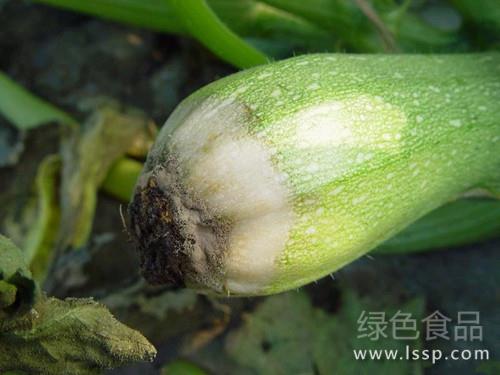
Zucchini gray mold
Gray mold harms zucchini flowers, fruits, stems, leaves and other organs. The pathogen first invades wilted female flowers. At the early stage of infection, the petals appear water-soaked or water-soaked-like, then become soft and rot, with a gray-brown mold layer appearing, causing the petals to rot, wilt and fall off. The pathogen then develops toward young fruits, and the affected parts become soft and rot, followed by a large amount of gray mold layer. If diseased tissue falls on leaves or stems, it can also cause disease in stems and leaves. Irregular large spots form on leaves, with brown concentric rings in the center, and when humidity is high, a gray mold layer can be seen. When stems are infected, gray-white lesions appear, and after girdling the stem, the stem can break.
Clean the field and greenhouse film: promptly remove diseased leaves, flowers, fruits, etc., take them out of the greenhouse, and bury them deeply or destroy them. Clean the greenhouse film to increase light transmission, thereby improving zucchini growth and enhancing disease resistance.
Regulate greenhouse temperature and humidity: use high-ridge mulching or drip irrigation cultivation methods, water at the right time, and keep the temperature relatively high in the morning as much as possible, which can inhibit pathogen sporulation and cause dew in the shed to vaporize and evaporate. Increase ventilation in the afternoon to lower humidity in the shed, and appropriately raise the shed temperature at night to reduce or avoid condensation on leaf surfaces.
Prevent pathogen invasion from wounds: when using 2,4-D to dip flowers, because it easily causes wounds and favors pathogen invasion, carbendazim and other fungicides can be added to the 2,4-D when dipping flowers to control pathogen invasion. In addition, during farming operations, try to avoid causing wounds and reduce artificial spread of the disease.
Pay attention to application methods: in chemical control, minimize spraying to avoid increasing humidity in the shed. Methods such as smoke agents or dust agents can be used, and various pesticides should be applied alternately in rotation to slow down resistance of zucchini gray mold to pesticides.