How to prevent and control forked, bent, and cracked deformed radish roots?
Forked, bent, and other deformed fleshy roots, as well as cracking that forms split roots, are common phenomena in radishes and seriously affect radish yield and quality. Radish roots have lateral roots on both sides; under normal conditions, these lateral roots do not swell. But under special conditions, the lateral roots can swell, and the result of this swelling is the formation of two or more forks. If the plow layer is too shallow, the downward growth of the fleshy root is obstructed, leading to bending or deformity.
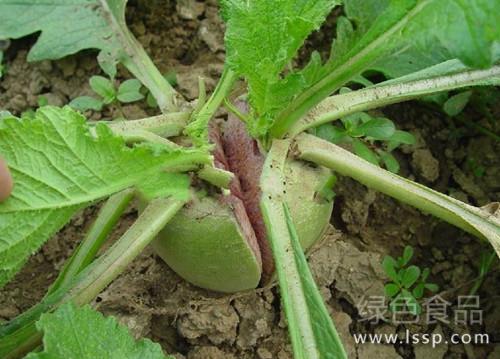
Radish root cracking
1. Soil conditions: When stones, bricks, tiles, and other hard objects are mixed into the soil, or when plastic film, glass, and other items are mixed into applied garbage compost, the normal elongation and swelling of the taproot are hindered. During the elongation of the radish fleshy root, when the main root encounters the above objects, obstructed elongation causes the lateral roots to swell and form forks or bends. For the radish main root to swell, the soil must have good aeration and high oxygen content. If the irrigation amount is too large or the soil moisture content is too high, aeration is poor, and combined with physical compression, main root thickening is inhibited. When soil aeration conditions improve slightly later, the lateral roots swell and form “beard-like” lateral roots. Soil compaction, too shallow a plow layer, and heavy clay soil texture can also hinder normal swelling of the fleshy root and cause forked or bent roots. Under normal circumstances, long-shaped varieties are more likely to produce deformed roots than short-shaped varieties.
2. Fertilization conditions: Applying large amounts of undecomposed compost, livestock manure and urine, and other organic fertilizers, or topdressing urea, ammonium bicarbonate, and other chemical fertilizers at too high a concentration can also easily cause deformed radish roots. This is because when the tip of the radish taproot encounters fermenting compost, high-concentration livestock urine, or chemical fertilizer, it often dies, breaks, or has its growth obstructed and cannot continue to elongate, while the lateral roots swell instead, thus forming forked or bent roots. In addition, during the fleshy root swelling period, applying too much nitrogen fertilizer causes excessive leaf growth, which is unfavorable for fleshy root swelling and also easily causes lateral root swelling or main root bending, forming forked or bent roots.
3. Temperature conditions: Spring radishes are generally sown from November to April of the following year, which coincides with winter and spring, when both air temperature and ground temperature are low. In particular, it is very difficult to artificially raise the ground temperature below 15 cm in the plow layer. Continuous irrigation reduces soil porosity, makes the soil layer compact, and easily forms a frozen soil layer, causing poor downward penetration of the main root after the radish splits open, affecting the swelling of the middle and lower fleshy roots and forming deformed roots. Therefore, one month before sowing, first cover the greenhouse film to build up warmth, deep-plow the plow layer to improve moisture retention, water thoroughly after sowing, and cover with plastic film. This can resolve the conflict between water and temperature and ensure normal growth of spring radishes.
4. Underground pests, such as those that bite and injure the tips of young radish roots, inhibit taproot growth and can also cause lateral root swelling, resulting in forking or deformity.
Improper cultivation management can also cause radish deformity. For example, in some radish varieties with long fleshy roots, sparse planting is more likely to cause forking and bending than dense planting; in management, bruising one side of the hypocotyl of radish seedlings can form mildly curved roots, and so on. Measures to prevent and control deformed roots: The cultivation site should be selected as deep, well-drained sandy loam soil without gravel, bricks, tiles, and other hard objects; deep plow and harrow finely, prepare the land carefully, and remove waste agricultural film; fertilization should be uniform, organic fertilizer should be fully decomposed, and chemical fertilizer topdressing should be applied in appropriate amounts; irrigation should be appropriate, and soil waterlogging or soil compaction should not be caused; thinning, intertillage, weeding, and other operations should be done carefully so as not to cause mechanical damage to radish seedlings; and underground pests in the soil should be controlled promptly. Before sowing, soil insecticides can be applied.