How to harvest Chinese chives for stable yields? Remember these precautions
Chinese chives can grow continuously in a greenhouse, so growers generally increase harvesting frequency to obtain more yield, but this practice weakens the growth of Chinese chives, reduces quality, and even worsens disease. Reasonable harvesting, however, can improve the nutrient status of the rhizomes of Chinese chives, help promote stable growth, and ensure good quality and stable yields.
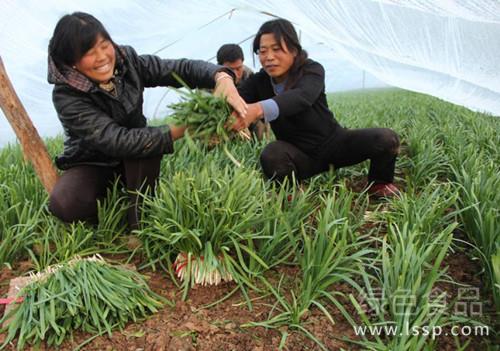
Harvesting Chinese chives
Harvest timing should be appropriate:The optimal harvesting interval for greenhouse Chinese chives is 30—40 days. At this time, the plant height of Chinese chives is generally 30—40cm, the number of leaves reaches 5—7, and the content of various nutrients is also relatively high, putting quality and yield in the optimal state. If harvested too early, the overall height and nutrient accumulation of Chinese chives are insufficient, and the yield is relatively low; if harvested too late, the plants are prone to lodging, old leaves are prone to yellowing, and the risk of disease infection increases. When diseases such as gray mold occur, if the height of Chinese chives has already exceeded 25cm, considering various factors comprehensively, an early harvest can be carried out, which helps disease prevention and control and maintains overall yield.
It is advisable to use a sharp, clean sickle, in the morning or evening on a sunny day, with harvesting after the humidity in the shed has been released in the morning being best. In the early morning, Chinese chives are full of water and stand upright and straight; after harvesting, they are fresh and crisp, with a rich flavor, short storage and transport time, and better yield and quality, which is good for sales. Harvesting is not advisable on days with low temperature and little sunlight, because under such weather the shed is often humid and cold, the growth of Chinese chives is slow, and their vigor is relatively weak, so the wounds after harvesting are prone to disease infection.
The stubble height should be moderate:Stubble height refers to the distance between the harvesting position and the upper end of the bulb (hulutou) of Chinese chives, and a height of 3—4cm is ideal. Judging from the color of the cut, the cross-section should be light yellow; if the color is greenish, it indicates the stubble is too high, and if it is whitish, it indicates the stubble is too low. If the stubble of Chinese chives is too high, it affects the yield and quality of the current crop; if the stubble is too low, it easily damages the meristematic tissue at the base of the leaf sheath, delays the harvest time of the next crop, affects the yield of the next crop, reduces the total annual yield, and also causes premature aging of Chinese chives and decreased disease resistance.
The number of harvests should be appropriate:The number of harvests should be determined according to the growth of Chinese chives, field water and fertilizer conditions, pests and diseases, and market demand. For the entire winter and spring, 3 times is best, and no more than 4 times at most.
Post-harvest management should be appropriate:Within one week before harvesting greenhouse Chinese chives, watering and fertilizing should be avoided, and ventilation should be strengthened to remove moisture; after harvesting, insulation in the shed should be strengthened, and watering and fertilizing should not be done before new leaves grow to 4—5cm.