Apple rough bark disease causes raised, cracked and sunken bark surface. How to prevent and control it?
In recent years, apple rough bark disease has shown a worsening trend, causing many apple trees to lose branches or die, seriously affecting apple quality, yield and profitability. Many fruit growers have had no choice but to dig up their trees and destroy their orchards, ruining their own "money bags."
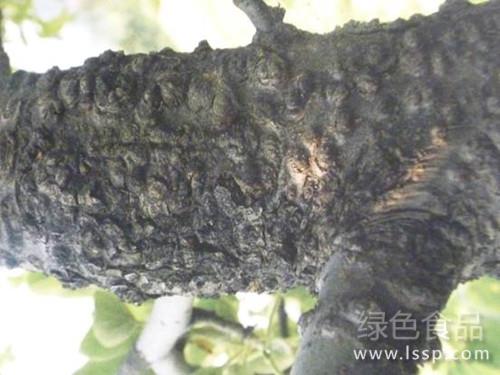
Apple rough bark disease
1. Symptoms: Rough bark disease mainly occurs on apple branches and trunks. It generally first forms hard, rash-like dark brown small protrusions on the surface at the tips of new shoots, bulging out from the phloem, appearing around the lenticels, slightly higher than the bark surface, with no attached organisms. The small protrusions gradually extend to the middle and base of the new shoots and to the main trunk. In the later stage, the diseased patches gradually expand, crack and become sunken, interlocking with one another. When the diseased bark is scraped open, black spots and black vein-like threads can be seen; in severe cases they reach the xylem, causing branches and the apple tree to die. Rough bark disease also appears on young leaves, where the leaves become smaller and chlorosis appears between the veins and along the leaf margins. In apple orchards with severe rough bark disease, leaves drop early in autumn and buds sprout late in early spring.
2. Causes: Excess manganese causes toxicity in the tree. Causes of excess manganese:
1. Soil is too acidic. According to surveys, the pH of apple orchards with severe rough bark disease is all below 7, with most around 5.
2. High manganese content in the tree. The normal range of manganese content in apple leaves is 30-150 mg/kg; above 150 mg/kg, the tree is prone to rough bark disease.
3. High available manganese content in the soil. When the manganese content in apple orchard soil exceeds 10 mg/kg, rough bark disease is prone to occur.
4. Low soil organic matter content. When the organic matter content in an apple orchard is below 0.6%, rough bark disease is prone to occur.
5. Low-lying orchard and heavy clay soil. Poor drainage and severe waterlogging cause large amounts of manganese in the soil to be reduced, making rough bark disease prone to occur.
3. Prevention and control measures:
1. For acidic soil, broadcast quicklime at 200 kg per mu, or apply 150 kg of calcium carbonate or silicon-calcium fertilizer per mu, then shallow hoe and water to neutralize soil acidity. Do not use physiologically acidic fertilizers such as ammonium sulfate and potassium chloride.
2. Do not spray manganese-containing fungicides or foliar fertilizers on the leaves. Apple orchards need to spray organic fungicides 11-12 times per year. Do not spray mancozeb or maneb or fungicides containing these two ingredients; instead, spray manganese-free fungicides such as iprodione and thiophanate-methyl. Foliar fertilizers should also not contain manganese.
3. Do not use manganese-containing inorganic compound fertilizers in the soil.
4. Increase soil organic matter. Apply more high-quality farmyard manure, at over 5,000 kg per mu. Apply 100 kg of liquid humic acid flush fertilizer per mu. Grow grass between rows as green manure. Cover the tree with grass to bring soil organic matter content to above 1%.
5. Prevent waterlogging in apple orchards. Apple orchards should as far as possible not be built on waterlogged low-lying land. On flat land, drainage ditches should be dug properly to avoid waterlogging in the orchard, which produces manganese reduction, causes manganese toxicity and worsens rough bark disease.