How to prevent and control black heart rot in celery with dark brown diseased parts bearing small black spots
During the growth of celery, symptoms such as black heart rot often appear due to infection by pathogens, nutrient deficiency and other reasons, and targeted measures should be taken to prevent and control them.
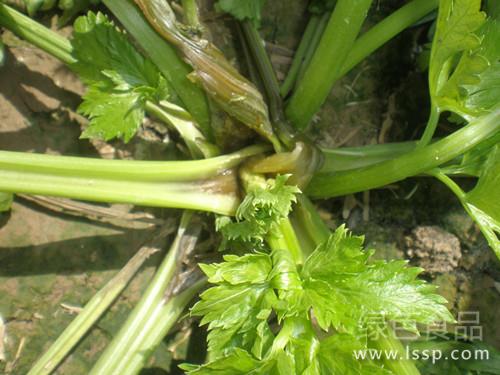
Celery black heart rot
1. Black rot. The pathogen of this disease invades from the base of the celery stem or the base of the leaf stalk, causing disease near the ground, then infecting upward, resulting in rot of the heart leaves. The diseased part is dark brown and rotten, sometimes producing small black spots. Prevention and control should be carried out as early as possible, using comprehensive measures. (1) Seed treatment: soak in warm water at 48°C for 20-30 minutes, then transfer to cold water to cool, remove and dry before sowing. (2) Agricultural control: use disease-resistant varieties; implement a 2-3 year crop rotation, preferably paddy-upland rotation; maintain a reasonable planting density to prevent the stems and leaves from closing over; in the rainy season, drain water promptly, prevent rainwater from flowing into the greenhouse, and strictly avoid flood irrigation; during cultivation, promptly remove diseased leaves and diseased plants, and immediately and thoroughly clear away diseased plant residues after harvest. (3) Chemical control: in the early stage of disease, spray with 50% thiophanate-methyl wettable powder at 500 times dilution, or 77% copper hydroxide wettable powder at 500 times dilution, 50% carbendazim wettable powder at 600 times dilution, 50% benomyl wettable powder at 1500 times dilution, 30% copper oxychloride suspension concentrate at 800 times dilution, 30% basic copper sulfate suspension concentrate at 400 times dilution, 40% chlorothalonil suspension concentrate at 600 times dilution, etc., once every 7-9 days, spraying 2-3 times in succession.
2. Soft rot. Celery soft rot, also known as "rotten lump", is a bacterial disease, generally prone to occur when the rows close over and shade the ground and the ground is damp. It mainly occurs on the base of the celery leaf stalk or on the stem. Prevention and control methods: (1) Agricultural control: implement a crop rotation of more than two years; during transplanting, intertillage, weeding and other operations, avoid damaging roots or causing wounds. Do not transplant too deeply, and do not hill up soil too high, so as to avoid burying the leaf stalks in the soil; drain water promptly after rain; when diseased plants are found, remove them promptly and spread lime or the like for disinfection; during the disease period, reduce or stop watering, and prevent flood irrigation. (2) Chemical control: in the early stage of disease, begin spraying 72% agricultural streptomycin sulfate soluble powder or new phytomycin at 3000-4000 times dilution, 14% copper ammonium complex water agent at 350 times dilution, 50% copper succinate-glutarate wettable powder at 500-600 times dilution, once every 7-10 days, spraying 3-5 times in succession.
3. Calcium deficiency. When celery is deficient in calcium, the young tissues of the growing point are initially brown, then turn black, until they die, and at the same time the disease extends downward to the stem base and roots, causing the stem surface to turn brown and dry up; when the growing point is cut open, the interior is hollow, in a brown dry-rot state, with a slight sour smell. Prevention and control methods: (1) Control the amount of fertilizer, especially in saline-alkali soil, strictly control the amount of nitrogen and potassium fertilizer to prevent the salt concentration of the plow layer soil from being too high and inhibiting calcium absorption. (2) Foliar calcium spraying: when celery is deficient in calcium, because the soil solution concentration is high, applying calcium to the soil is often ineffective, so a 0.3%-0.5% calcium chloride or calcium nitrate solution can be sprayed on the leaves. (3) For acidic soil with insufficient calcium supply, calcium-containing fertilizers such as gypsum can be applied, or lime can be applied.
4. Boron deficiency. Celery is sensitive to boron; boron deficiency in the soil, or drought, or excessive application of nitrogen fertilizer causing boron deficiency in celery, will cause the stems and leaf stalks to split, through which bacteria invade, making the celery heart leaves turn black and rot. Prevention and control methods: if the soil is deficient in boron, apply 1 kg of borax per mu to supplement the boron element; after boron deficiency symptoms are found, a 0.1%-0.3% borax aqueous solution can be used for foliar spraying.