Lettuce downy mildew causes white mold on the undersides of leaves, yellowing and drying up. How should it be prevented and controlled?
Lettuce is one of the vegetables that come to market earlier in early spring. Because of low investment and simple cultivation, its planting area keeps expanding, and as the years of cultivation increase, pests and diseases worsen. Downy mildew is one of the main diseases of lettuce, severely damaging the leaves, affecting lettuce growth and quality, and affecting income.
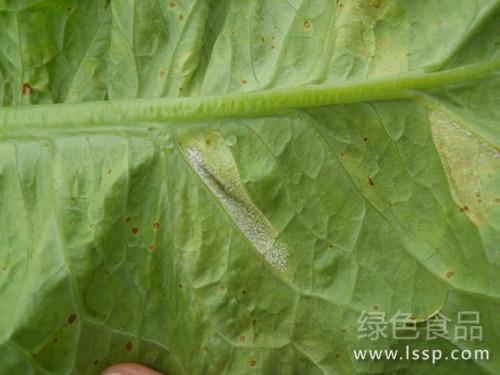
Lettuce downy mildew
1 Damage symptoms:
Downy mildew mainly damages lettuce leaves. In the early stage of the disease, pale yellow nearly round or polygonal lesions first appear on the lower leaves of the lettuce. White mold grows on the leaf undersides, gradually spreading upward. In the later stage the lesions turn yellowish brown. When the disease is severe, most lesions join into one, the leaves turn yellow and dry up, and finally the lettuce surface turns brown and black, and even the whole plant rots.
2 Disease occurrence pattern:
The pathogen of lettuce downy mildew is Bremia lactucae. The pathogen overwinters as oospores in the soil with diseased residues, or as mycelium inside seeds, or on autumn-sown celtuce, as the primary infection source for the next season, and produces sporangia the following spring. It spreads by wind and rain and insects. After contacting the host, it invades through the host epidermis or stomata and can cause repeated infection and damage. Disease occurrence is closely related to climate, especially temperature and humidity. The optimum temperature for germination of the pathogen's sporangia is 6-10 degrees C, and the suitable temperature is 15-17 degrees C. Infection by the pathogen requires a relative humidity above 85% and a certain period of dew formation, so low temperature and high humidity favor disease occurrence. In plots planted too densely, with an overly large plant population, excessive nitrogen fertilizer use, and poor ventilation and light penetration, the disease occurs severely.
3 Prevention and control methods:
3.1 Crop rotation: On plots rotated with non-Asteraceae vegetables, heavily diseased land should be rotated with other non-Asteraceae vegetables for more than 2-3 years. After harvest, remove diseased residues from the field or greenhouse to reduce the source of inoculum.
3.2 Strengthen cultivation management: Planting density should be reasonable, avoiding excessive density and overcrowding within the plants, which is not conducive to ventilation and moisture dispersal. Greenhouse management should be scientific, with less watering or under-film irrigation. Adopt high-ridge cultivation with full plastic film mulching. Base fertilizer should be applied with a combination of nitrogen, phosphorus and potassium fertilizers, and more organic fertilizer should be applied, which can improve the disease resistance of lettuce.
3.3 Chemical control: Before sowing, seed treatment can be done by mixing seeds with 0.3%-0.4% thiram or 0.2%-0.3% metalaxyl to kill pathogens on the seed surface and reduce the source of infection. In the early stage of the disease, carry out chemical control promptly to control the spread of the pathogen. For chemical control, spray with 75% dimethomorph 500 times, or 72% cymoxanil mancozeb 600 times, or 64% oxadixyl mancozeb 500 times, or 69% dimethomorph 700 times, once every 5-7 days, spraying 2-3 times in succession. For lettuce planted in greenhouses, fumigate with 45% chlorothalonil smoke agent at 350 g per mu.