Tomato blossom end rot control methods: how to handle sunken, flattened black-brown spots at the blossom end
In recent years, blossom end rot of greenhouse tomatoes has occurred from time to time. This disease is a physiological disorder that greatly affects yield and lowers the commercial value of tomatoes.
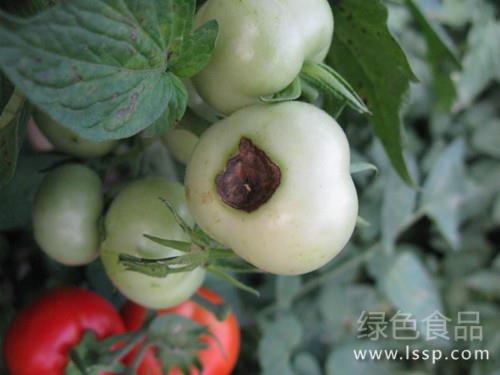
Tomato blossom end rot
I. Symptom identification:
Blossom end rot can occur on tomatoes from the size of a thumb until before they color and ripen, and the lesions appear only at the blossom end of the tomato. The lesions are initially dark green and water-soaked, and soon become dark brown or black necrotic spots 1—2cm in diameter or larger; the flesh of the lower part of the tomato dries out and shrinks, the blossom end becomes sunken and sometimes cracks, the fruit becomes flattened, and the flesh becomes sweet. In severe cases, the lesion expands to half the fruit surface, the tomato stops enlarging and turns red prematurely, and the skin becomes tough and lusterless, losing its value.
II. Causes of blossom end rot:
First, during the fruit enlargement stage, water supply is uneven; especially under drought or when the root system's water-absorbing capacity is weak, water supply becomes unbalanced, the blossom end of the fruit cannot compete for water and its growth is hindered, forming blossom end rot; second, calcium deficiency causes physiological disturbance of the cells at the blossom end of the tomato, leading to the disease.
III. Conditions affecting the occurrence of blossom end rot:
Soil texture: strongly sandy soil that leaks water and fertilizer severely, and plots with high salinity and alkalinity have more severe disease; terrain: plots with steep slopes where water and fertilizer are easily lost have more severe disease; soil calcium content: soil calcium, with relatively little organic acid, especially insufficient soluble calcium; growth stage: insufficient water supply when tomatoes are flowering and fruiting heavily, or topdressing too late, suddenly raising the soil solution concentration.
IV. Control methods:
Controlling nitrogen application, balanced fertilization of nitrogen, phosphorus and potassium, and appropriate foliar calcium spraying are helpful for controlling blossom end rot.
1. In conjunction with land leveling, apply sufficient base fertilizer. For tomato base fertilizer, use decomposed organic fertilizer plus phosphorus and potassium chemical fertilizers, such as ordinary superphosphate and potassium sulfate, or a compound fertilizer with medium nitrogen, medium phosphorus and potassium-rich formula. For example, applying 30—40 kg of superphosphate per mu and mixing it into organic fertilizer for fermentation is even better.
2. Irrigate at the right time to prevent the soil from drying and wetting alternately, and do not let the soil become excessively dry. For the first watering at transplanting and the second watering when fruit setting begins, the amount of water should not be too large; only after the third truss has finished flowering and the first cluster of fruit is as large as an egg should a heavy watering be given. Keep the soil moist; in summer, watering should be done in the early morning or evening, and be sure to water frequently and lightly.
3. Combine foliar and root calcium supplementation. For topdressing calcium fertilizer outside the roots, the 30 days after fruit setting is the key period for calcium uptake, so starting from the early flowering stage, spray the leaves with 1% superphosphate or 0.1% calcium chloride or calcium-containing compound fertilizer, once every 15 days, for 2~3 consecutive sprays.