Century cold wave sweeps across most of China, how to prevent post-snow frost damage in wheat?
Recently, a century cold wave has swept across most parts of our country, with overcast and rainy days and frost damage affecting crop growth. To protect wheat from low-temperature frost damage during snowy weather, the following measures can be taken:
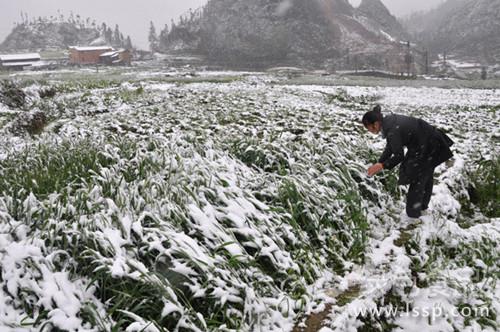
Wheat snow disaster
Fertilizing and earthing up: For wheat seedlings with poor field preparation quality and large clods that leave roots exposed, soil manure or earthing up can be used to protect against freezing and preserve the seedlings.
Water early: For wheat fields where leaves have been frost-damaged but young spikes have not been damaged, water should be applied early to prevent the young spikes from dehydrating and dying.
Apply nitrogen fertilizer: For wheat fields where young spikes have already been frost-damaged, quick-acting nitrogen fertilizer should be applied, with 10-13 kg of ammonium nitrate or 20-30 kg of ammonium bicarbonate per mu, combined with watering and intertillage loosening of the soil, so that the frost-damaged wheat seedlings can resume growth as soon as possible.
Two topdressings: For wheat fields where the main stem and large tillers have already been frozen to death, fertilizer should be applied twice. The first is to apply quick-acting nitrogen fertilizer immediately after the field thaws, with 10 kg of urea per mu, requiring application in furrows to improve fertilizer efficiency. For moisture-deficient wheat fields, apply it with water. The second is at the wheat jointing stage, applying jointing fertilizer together with watering at jointing, with 10 kg of urea per mu.
Increase phosphate fertilizer: Phosphorus promotes wheat tillering and root growth. For phosphorus-deficient wheat fields, urea and diammonium phosphate can be applied together.
Spray chlormequat: When wheat suffers frost damage, spraying the wheat seedlings with a 0.3%-0.5% chlormequat solution can inhibit growth and resist or reduce the occurrence of frost damage.
Prevent premature senescence: Frost-damaged wheat is prone to premature senescence in the later stage. Fertilizer and water management in the middle and late stages can be strengthened. On the basis of the first topdressing in spring, fertilizer should be applied in an appropriate amount at the jointing stage according to the growth of the wheat seedlings, to promote larger spikes and more grains.