Control Measures for Snow Damage and Pests and Diseases After Bayberry Branches Are Broken by Heavy Snow
Bayberry is an evergreen fruit tree. Because its branches and leaves are dense and its canopy is closed, it easily accumulates snow, and its branches are brittle and easily broken by accumulated snow. In particular, bayberry trees growing in places with shallow soil are often uprooted or toppled. There are mainly three aspects:
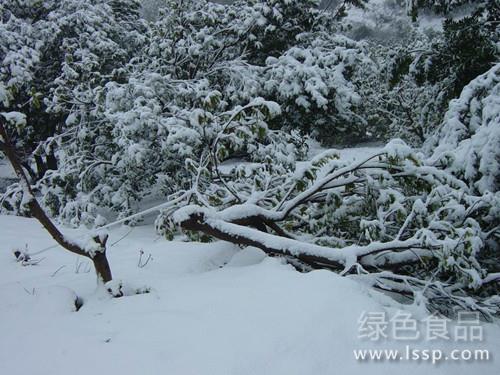
Snow Damage in Bayberry
(1) Freezing injury: The lowest temperature that bayberry trees can tolerate is -9°C. During the snowmelt period, alternating freezing and thawing and uneven cold and heat cause freezing injury to bayberry branches, leaves, and flower buds, resulting in poor flower bud differentiation and reduced yield.
(2) Injury: After bayberry trees growing in shallow places topple or are uprooted, the root system is injured and nutrient transport is blocked. For those more severely injured and with entire branches sawed off, it takes 2 years before they bear fruit again; for those less severely injured, with only part of the roots and branch tips pruned, flower bud differentiation is instead promoted, and the bayberry trees bloom more, have a high fruit-setting rate, and produce small fruit of low quality, which affects the amount of spring shoot growth and forms alternate bearing.
(3) Pests and diseases: Although heavy snow can kill some overwintering pests and pathogens in bayberry orchards and reduce spring diseases, after bayberry branches and leaves are bruised, the wounds heal slowly. After the beginning of spring, pathogens invade through the wounds and promote the spread of bayberry crown gall, brown spot disease, and felt disease, leading to outbreaks of moths and other pests.
II. The "three-part" management:
(1) Before heavy snow: Set up props for bayberry trees or tie them with ropes. In particular, the outer canopy with many branches and leaves should be pruned in advance by the "thinning branches" method; where snow damage often occurs, use the natural open-center large-branch pruning method (commonly known as "opening the skylight"), so that the branches are sparsely distributed to facilitate the fall of accumulated snow and reduce snow damage.
Remove accumulated snow from bayberry
(2) During heavy snow: Manually shake off the accumulated snow on bayberry trees in time. Regardless of whether the snow has stopped, once accumulated snow is found on the canopy, shake it off promptly or knock it off with bamboo poles to reduce the amount of snow on the canopy.
(3) After heavy snow: Promptly strengthen care for bayberry trees. After snow damage, bayberry trees have many wounds and weakened tree vigor, so the orchard should be cleaned promptly, fertilizer supplemented, soil mounded, and pesticides sprayed to restore tree vigor as soon as possible.
III. Management measures:
(1) Clean the orchard promptly: If snow still remains on bayberry trees after the snow stops, shake it off as soon as possible to avoid branch and trunk breakage; promptly remove props or bindings and deal with broken branches and trunks. For completely broken ones, saw them off early, smooth the wounds, and apply protective agents such as grafting wax to prevent rot; for those torn but not broken, do not saw them off easily. First lift them with ropes or support them with props to restore their original position, apply grafting wax and the like to the injured parts, and tie them firmly to promote healing and restore growth; for partially toppled ones, retract large branches, then cut the broken roots smooth, with a height below 2.5 m, and loosen the soil where the roots were broken, dig out some of the broken roots, straighten the tree body, then fix it with large branches or ropes, rebury the roots in the soil, fill with new soil, and firm it; in severe cases, build a ring of stones around them, fill the inside firmly with soil, straighten the tree body, and apply protective agents such as grafting wax to the wounds to prevent cracking from sunlight or rot from accumulated water.
(2) Promptly mound soil and supplement fertilizer: For bayberry trees with part of the root mass exposed, add foreign soil promptly and supplement with a small amount of quick-acting fertilizer. For the foreign soil, it is best to use fresh yellow soil from under bracken or surrounding topsoil. The amount of base fertilizer is determined according to the canopy, growth vigor, and other conditions. Generally, apply 0.2-0.3 kg of compound fertilizer containing potassium sulfate per tree or 0.l-0.2 kg of urea. Where conditions permit, spray foliar liquid fertilizer such as 1000-1200 times dilution of high-efficiency rare earth, or 0.2% potassium dihydrogen phosphate, or 0.2% urea, as much as possible, to quickly replenish the nutrients of the tree body.
(3) Spray pesticides promptly: After snow damage, promptly focus on the control of bayberry brown spot disease, moths, and other pests and diseases. For bayberry production areas with relatively serious pests and diseases, adopt the "mass prevention and mass control" method; for bayberry trees with weak growth vigor or older tree age, on the basis of pruning, promptly carry out control to reduce pathogens and pests and maintain good growth vigor as much as possible. The pesticides can be 800-1000 times dilution of 15% carbendazim, or 1000-1200 times dilution of 70% thiophanate-methyl, or 800 times dilution of 65% mancozeb.