What are the control methods for whiteflies? Master these tips to effectively eliminate the pests
What harm do whiteflies cause? What control methods are there for whiteflies? We ask experienced netizens to help explain. Whiteflies, also called small white moths, are a worldwide pest that occurs everywhere in our country. Whiteflies harm cucumber, kidney bean, eggplant, tomato, chili pepper, winter melon, beans, lettuce, as well as Chinese cabbage, celery, large...
 What harm do whiteflies cause? What control methods are there for whiteflies? We ask experienced netizens to help explain
Whiteflies, also called small white moths, are a worldwide pest that occurs everywhere in our country. Whiteflies harm 653 plant species in 112 families, including cucumber, kidney bean, eggplant, tomato, chili pepper, winter melon, beans, lettuce, Chinese cabbage, celery, scallion, flowers, fruit trees, medicinal herbs, forage grass, and tobacco. Therefore, Zhongdi Network has compiled the harm and control methods of whiteflies, listed in detail below for netizens' reference.
The harm of whiteflies:
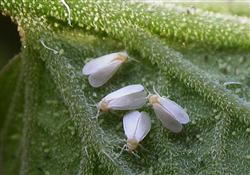
Whitefly adults are about 0.9-1.4 mm in size, pale yellowish-white or white, with wings in both males and females, and the whole body covered with white waxy powder. Females are larger than males, and their ovipositor is needle-shaped.
Whiteflies mainly feed on plant sap as adults and nymphs, causing the leaves of affected crops to lose green color, turn yellow, and wilt, and even causing the whole plant to die. Moreover, whiteflies have strong reproductive capacity and fast reproduction speed, with huge population numbers, gathering in groups to cause damage, and secreting large amounts of honeydew, which severely contaminates leaves and fruits, often causing major outbreaks of sooty mold and making vegetables lose their commercial value.
Control methods for whiteflies:
Method 1. Use sticky insect boards for trapping and killing:
Use yellow boards 1*0.2 m in size, coat them with No. 10 machine oil, and hang them in greenhouses, at field edges, or between crop rows where whiteflies are present; after the sticky insect boards are covered with trapped whiteflies, brush them off with a brush, apply oil again, and trap and kill again.
Method 2. Use Encarsia formosa:
Artificially release Encarsia formosa. Release 3 adult Encarsia formosa per plant every 5 days, for a total of 3 releases. Encarsia formosa can establish a population in greenhouses and effectively control whitefly damage. Encarsia formosa mainly lays eggs inside whitefly larvae and pupae, causing whitefly larvae and pupae to turn black and die in 8-9 days.
Method 3. Greenhouse fumigation method:
Sprinkle dichlorvos on sawdust, reed stalks, rice straw, etc., then add a piece of red-hot coal ball to fumigate with smoke. Each mu of greenhouse requires about 0.4-0.5 kg of 80% dichlorvos emulsifiable concentrate; alternatively, each mu of greenhouse can use 150 ml of 80% dichlorvos emulsifiable concentrate, 14 kg of water, and 40 kg of sawdust, mix well and scatter between rows, close doors and windows, and fumigate for 1-1.5 hours, with the temperature controlled at about 30°C. The control effect is very good.
Method 4. Chemical control:
Use 2.5% buprofezin wettable powder at 2500-3000 times dilution to control eggs, nymphs, and adults. During the peak period of young nymph occurrence, spray 25% buprofezin wettable powder at 1000 times dilution, or 40% omethoate emulsifiable concentrate at 1000 times dilution, 8% shachongwei wettable powder at 1500 times dilution, 20% methomyl emulsifiable concentrate at 1000 times dilution, 44% suikai emulsifiable concentrate at 1500 times dilution, or 20% imidacloprid (Confidor) soluble concentrate at 3000-4000 times dilution.
The above effective pesticides should be used in rotation to slow the development of pesticide resistance. Aim the selected pesticide at the underside of the leaves and spray once every 5-7 days, for 3-4 consecutive sprays. The control effects are all above 98%.
How to make sticky insect boards
What harm do root-knot nematodes cause