Overwintering cultivation techniques for celery in greenhouses, helping to achieve year-round celery supply
Overwintering celery in greenhouses is mainly grown by raising seedlings and transplanting, which helps increase yield and quality, improve land utilization, reduce costs, and also ensure full and uniform seedlings. For raising seedlings and transplanting, choose a plot with loose, fertile soil as the seedling bed, and before raising seedlings, the seeds must also be treated, which can make the seeds germinate fully, the seedlings vigorous, and help the celery grow robustly.
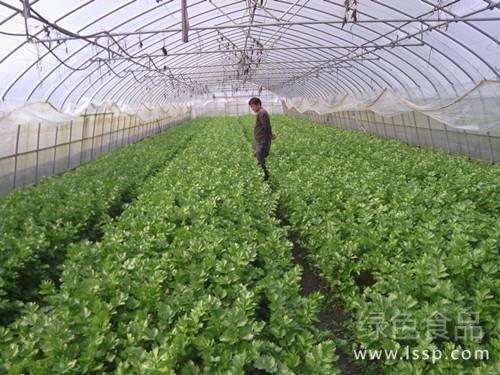
Greenhouse celery
1. Growth period management: After planting is completed, promptly water thoroughly to help the seedlings recover, then water again after 2-3 days, and spray with New High-Fat Film, which can effectively prevent aboveground moisture from evaporating, prevent moisture in the seedling body from transpiring, isolate pests and diseases, shorten the seedling recovery period, and enable the celery to quickly adapt to the new environment and grow healthily. After the celery has recovered, watering should be controlled and seedling hardening carried out, generally for about 15 days, to promote downward root growth, stooling, and differentiation of the heart leaves. Spraying Vegetable Strong Stem Spirit at the appropriate time can make celery stalks thick and strong, leaves thick and plump, leaf color fresh and tender, and lush, with a strong natural taste. At the same time, it enhances resistance to disasters, reduces the amount of pesticides and chemical fertilizers, and lowers residual toxicity.
2. Fertilizer and water management: Once celery enters the growth period, growth accelerates and it needs more fertilizer and water. During this period, keep the soil moist and provide the celery with sufficient water and nutrients. At this stage, use irrigation-type watering, and combine watering with topdressing nitrogen fertilizer. When topdressing urea, put the urea in a bucket, add water to dissolve it, and apply it to the field with the water. Combining watering and fertilization can make fertilization uniform and help the fertilizer take effect. Using Root Application Agent together with micro-fertilizers to irrigate the roots in real time can induce the celery to absorb, digest, and release nitrogen, phosphorus, potassium, and various trace elements in the soil, enhance the positive energy of celery development, and optimize celery quality.
3. Temperature and humidity management: During the celery growth period, temperature and humidity must be well controlled. In winter greenhouses, the most suitable growth temperature for celery is 15-20°C. When the temperature is too high, celery growth stalls or even dies; if humidity is also high at the same time, celery under high temperature and high humidity is prone to spot disease, leaf spot disease, and other diseases. Spraying New High-Fat Film on the leaf surface can preserve soil moisture, prevent moisture evaporation, protect against sun and drought, keep warm and prevent freezing, prevent soil compaction, and suffocate and isolate pest and disease sources.
4. Cold prevention and heat preservation: In the cold northern weather, cold waves and cold air invade from time to time, and there are occasional sharp temperature drops. Because the suitable growth temperature for celery is 15-20°C, when the temperature is below 15°C for a long time, celery grows poorly. The main heat preservation measure for greenhouse celery is covering with straw curtains. If it is sunny with no cold wave, the straw curtains can be taken up at eight or nine in the morning, which not only helps raise the greenhouse temperature but also increases light, promoting celery growth. Spraying New High-Fat Film can prevent moisture evaporation, prevent bacterial infection, and provide freeze resistance and heat preservation.