Techniques for Raising Temperature to Break Dormancy and Humidity Management in Early Spring for Greenhouse Peach Trees
Peach trees grown in greenhouses must undergo a certain period of low temperatures and satisfy their chilling requirement before the temperature can be raised to break dormancy. For greenhouse-cultivated peach trees, artificial forced dormancy must be carried out, so that the peach trees go through a series of low-temperature hardening processes, complete their physiological changes, and ultimately sprout, grow, bloom and set fruit normally.
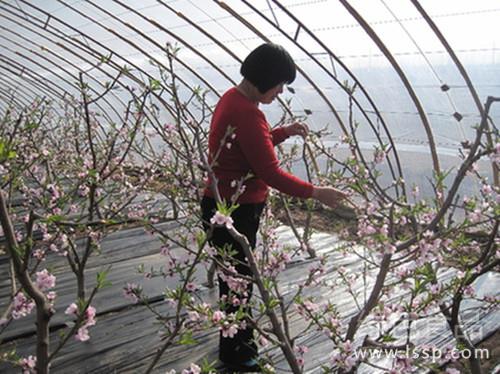
Greenhouse Peach Tree Management
Management During Temperature Raising:
1. Pest and Disease Control: When starting to raise the temperature, first spray an insecticide to kill overwintering pests on the peach trees such as red spider mites and aphids. Be careful to spray evenly. At the early stage of sprouting, spray 3—5 degrees Baumé lime sulfur mixture to eliminate all pathogens.
2. Soil, Fertilizer and Water Management: Within 10 days after raising the temperature, apply fertilizer and water. If no base fertilizer was applied or the base fertilizer was insufficient, after raising the temperature, apply 1 round of organic fertilizer as a top dressing, together with a small amount of compound fertilizer. After fertilizing, irrigate heavily once to soak the soil thoroughly, and when the soil is slightly dry, carry out 1 round of loosening the soil.
3. Mulching with Plastic Film: Mulching with plastic film helps raise soil temperature.
Temperature and Humidity Management in the Shed During the Bud Forcing Period:
1. Temperature Management: At the beginning, the temperature must not rise too fast or too high. If the temperature rises too fast and is too high, the peach trees will sprout quickly and bloom quickly, resulting in the phenomenon of buds appearing before flowers, causing leaf buds to compete for stored nutrients, which lowers the fruit-setting rate, seriously affects the development and swelling of young fruit, and causes young fruit to drop. Raise the temperature in 3 steps: Step one, during the day pull up only 1/3 of the straw mats, pulling one every other two, keeping the daytime shed temperature at 13°C—15°C and nighttime at 6°C—8°C, and maintain this for 2—3 days. Step two, during the day pull up 1/2 of the straw mats, pulling one every other one, keeping the daytime shed temperature at 16°C—18°C and nighttime at 7°C—10°C, for 2—3 days. Step three, during the day pull up all the straw mats; when the temperature is too high, open the top ventilation openings to ventilate and cool down, keeping the daytime shed temperature at 20°C—23°C and nighttime at 7°C—10°C.
2. Humidity Management: An air relative humidity of 70%—80% inside the greenhouse is favorable for peach tree sprouting. If the humidity is too high, it can be adjusted by ventilation and air exchange, controlling watering, and mulching with plastic film; if the humidity is too low, water can be sprinkled on the ground and tree bodies, misted or watered to increase humidity.
Temperature and Humidity Management During the Sprouting Period:
1. Temperature Management: For greenhouse-cultivated peach trees, temperature regulation is very important. If the temperature is too low, root activity of the peach trees is hindered and the trees sprout late; if the temperature is too high, leaf buds sprout early, leaves appear before flowers, affecting fruit setting. During the sprouting period, the daytime maximum temperature is 25°C and the nighttime minimum temperature is 0°C. The temperature regulation method for this period is to seal the greenhouse film tightly and close the ventilation openings. During the day pull up the straw mats to let in light and raise the temperature; at night cover the straw mats well to keep warm. The temperature inside the shed is mainly raised by sunlight and regulated by opening and closing ventilation openings and covering and uncovering straw mats. From the sprouting period to the flowering period, the daytime temperature is 10°C—18°C and the nighttime temperature is above 5°C.
2. Humidity Management: Humidity inside the shed includes soil humidity and air humidity. Since the shed is closed most of the time, air humidity tends to be too high; soil humidity can be adjusted by irrigation, and air humidity can be adjusted by ventilation and air exchange. When the humidity inside the shed exceeds 80%, on the premise of not affecting the temperature, use the ventilation dehumidification method to regulate it. In addition, humidity can also be reduced by the irrigation control method. If the soil is dry, after watering, plastic film can be mulched, or hole irrigation can be carried out in turns in batches; it is best to adopt the under-film irrigation method for peach trees.