Strawberry parasitic nematodes cause stunted plants and white nematodes in diseased parts - how to control them?
Nematodes are small and not easily detected, and the symptoms of damage in strawberries are easily mistaken for viral diseases or physiological disorders, so the correct pesticides may not be used, seriously affecting strawberry quality and yield. The symptoms of strawberry nematode disease and effective control techniques are described below.
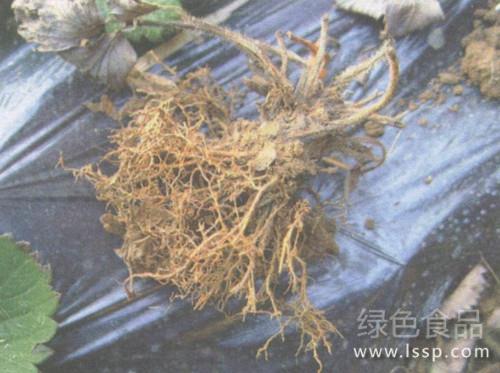
Strawberry nematode disease
I. Symptoms:
1. Foliar nematode disease. Nematodes do not invade strawberry tissues but feed on developing buds and leaf surfaces. After the leaves unfold, they show wrinkling and distortion and are smaller than normal leaves. Nematodes damage the fruit buds, causing reduced strawberry yield. When nematodes and pathogens infect together, strawberry plants show aboveground stunting, contracting into a fleshy rosette about 1 cm across.
2. Root-knot nematode disease. The root system of affected strawberries has root galls of varying sizes. When the diseased tissue is cut open, many tiny milky-white nematodes can be seen. The root system is poorly developed, lateral feeding roots proliferate, and aboveground growth is weak.
3. Root-rot nematode disease. Young plants are hard and turn brown, and adult plants have elliptical lesions on the roots, from yellow-brown to dark brown. The aboveground part of the strawberry is stunted, lacks vigor, and has low yield, with strong sensitivity to soil drought.
4. Stem nematode disease. Petioles are raised, leaves are twisted and deformed, galls form on flowers and strawberry fruit parts, and plants are stunted. When the deformed tissue is cut open, large numbers of nematodes can be seen in the cortex or parenchyma.
II. Control techniques:
1. Biological control. Use the natural enemies of nematodes in the soil - fungi and bacteria. Introduce beneficial bacteria into diseased strawberry plants to destroy the nematode contents and kill the nematodes. Alternatively, before planting, drench the planting holes with 1.8% abamectin at 3000 times dilution, 0.1-0.25 kg per hole, then plant and cover with soil, for a control effect of 85%-90%.
2. Physical control. Before planting strawberries, soak dormant mother plants in warm water at 46-55°C for 10 minutes to eliminate nematodes.
3. Strengthen cultivation management. Remove diseased plant residues and weeds and burn them in a centralized manner. Add organic matter to the soil, maintain soil fertility, irrigate reasonably, and cultivate strong seedlings to enhance the resistance and tolerance of strawberry plants. In heavily affected plots, a 2-3 year rotation with scallions, garlic, chives, aquatic vegetables, or gramineous crops can effectively suppress nematodes.
4. Chemical control. In plots with a history of the disease, before strawberry planting, apply 3% miler granular formulation at 1.5-2.0 kg per mu or 10% fenamiphos granular formulation at 2-4 kg per mu, by hole application or broadcast application, for a control effect of 85%-95%.