Improper fertilization of greenhouse vegetables easily burns seedlings and worsens diseases; what precautions should be taken?
At present, many greenhouse vegetables suffer from seedling burn, worsened diseases and other problems caused by improper fertilization. Based on typical experience summarized by experts on scientific fertilization of greenhouse vegetables, the following 5 points should be noted when fertilizing vegetables under protected cultivation:
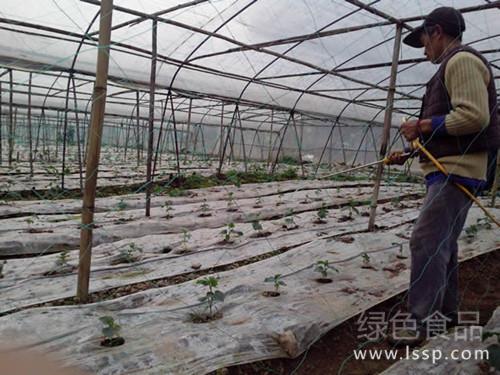
Fertilizing greenhouse vegetables
1. Apply chemical fertilizers in appropriate amounts:
Because greenhouse vegetables are grown under protective facilities, the soil cannot be fully leached by rainwater, and fertilizers are not easily lost through leaching. Therefore, excessive application of chemical fertilizers easily causes salts to accumulate in the surface soil, which at best affects vegetable growth and at worst leads to soil salinization. Therefore, before fertilizing, a soil nutrient diagnosis must be carried out and a reasonable formula fertilization plan must be made to prevent blind and excessive application of quick-acting fertilizers.
2. Pay attention to increasing potassium fertilizer application:
Applying potassium fertilizer to cucurbit and solanaceous vegetables has an obvious yield-increasing effect. This is because, with greenhouse vegetables being excessively fertilized with nitrogen and phosphorus chemical fertilizers year after year, the soil's potassium supply capacity weakens as the number of planting years increases and vegetable yields rise. According to experiments, when 7.5 kg of potassium oxide is applied per mu as a supplement to greenhouse cucumbers, the plants show thick stems, fresh green and thick leaves, and straight fruits; for winter Chinese cabbage, yield and quality are obviously improved. It should be noted that when choosing the type of potassium fertilizer, it is best not to use potassium chloride, so as to avoid soil salinization.
3. Topdressing should be done in small amounts but many times:
Vegetables need relatively large amounts of nutrients. In addition to applying sufficient base fertilizer, topdressing is also needed. When topdressing, it should be done in small amounts but many times. This can first prevent nutrient loss, and second fully exert fertilizer efficiency and improve fertilizer use efficiency.
4. For micronutrient fertilizers, supplement whatever is deficient:
Although vegetables require only small amounts of trace elements, micronutrient fertilizers are indispensable nutrients involved in the physiological functions within vegetables. If trace elements in the soil are insufficient, vegetables will show different deficiency symptoms, with reduced yield and declined quality. If trace element content in the soil is too high, it will also cause poisoning in vegetables, likewise resulting in reduced yield and lower quality. Therefore, supplemental application of micronutrient fertilizers must be carried out according to soil test results and the symptoms of vegetable deficiency, and must follow the principle of supplementing whatever is deficient.
5. Root-external topdressing must be accurate:
Foliar spraying is simple, saves labor and time, can avoid increasing the vegetable disease infection rate caused by excessive watering leading to high soil moisture, and can also quickly supplement nutrients. However, the application concentration must be controlled, otherwise fertilizer damage is likely to occur and "burn" the leaves. Generally, the concentrations for foliar spraying are: urea 1%, potassium dihydrogen phosphate 0.2~0.5%, diammonium phosphate 1%, zinc sulfate 0.1~0.2%, manganese sulfate 0.1~0.2%, borax 0.1~0.2%, ammonium molybdate 0.05~0.1%, copper sulfate 0.02~0.2%, ferrous sulfate 0.2~1%.