Technical Points for Why Early Spring Grafting of Bayberry Trees Is More Advantageous
For bayberry grafting, select 2-3 year old plump branches as scions, with a stem diameter of 0.8-1.5cm and a length of 5-6cm, increased or decreased according to the size of the rootstock. The key to affecting the survival rate of grafted bayberry lies in paying attention to wind protection after grafting, promptly setting up supports, and securing new shoots to prevent them from being broken by the wind.
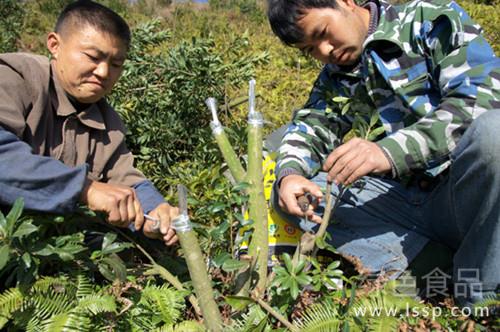
Bayberry Grafting
1. Scion collection:
For bayberry scions, select robust branches 2-3 years old from the outer periphery or top of the canopy, with a diameter of 0.5-1cm; fully matured spring shoots or summer shoots from the previous year are also acceptable. After the scions are cut, immediately remove the leaves, bark, and fine branches, and keep them moist. When grafting on site, collect the required scions and graft them immediately. For those collected over long distances, store them properly; they can be buried in layers in clean, moist fine sand and taken out as needed for grafting.
2. Rootstock selection:
Seedling trees grown from wild bayberry seeds are best; after grafting, they heal well and have strong resistance and adaptability. Regarding tree age, select seedlings cultivated for 2-3 years, with a tree age within 15 years.
3. Grafting time:
Bayberry grafting is generally carried out before spring bud break, and appropriately early grafting is more advantageous. From late February to early March, choose sunny days with high temperatures. If too late, bleeding will affect survival.
4. Grafting methods:
1. Cleft grafting: A common bayberry grafting method is horseshoe-shaped cleft grafting, also known as horseshoe-shaped, long-scion, full-film high grafting. When grafting, the scion should be longer than that used for grafting small seedlings, generally 7-10cm, and the length of the cut surface on the scion should be at least 1.5-2cm, preferably 3cm long, and is required to be smooth. The position of the scion on the rootstock must take future tree shape into consideration, requiring spreading and ample sunlight. To achieve this, branches reserved as the trunk, main branches, and secondary main branches should be required to grow obliquely outward with moderate vigor, avoiding grafting onto overly vigorous rootstocks to form the main structure. To avoid bare scaffold branches and increase fruiting positions, arrange scions in empty spaces and cultivate them as auxiliary nurturing branches to increase fruiting. The distance between scions should be more than 50cm to avoid excessive branches causing shading. The larger the angle between the grafted bud and the central leader, the better the sunlight and the better the fruiting. After grafting, wrap the wound with plastic film. After survival, new branches from the scion emerge from the slit in the film.
2. High grafting: The height of bayberry high grafting and the number of scions used should be appropriate to the age of the rootstock. For example, for 3-4 year old trees, graft high on the main branches at a height of 40-60cm, with 3-4 scions. For 5-7 year old trees, graft high on the main branches, secondary main branches, and side branches at a height of 80-120cm, with 10-15 scions, where the graft interface diameter is more than 3cm, and 1-2 scions are grafted per interface. For 8-12 year old trees, graft at a height of 150cm, with 15-20 scions, and carry out side supplementary grafting in empty areas of scaffold branches to increase fruiting branches. For 13-20 year old trees, graft high at 1.8-2.5m, with 25-30 scions, and carry out side summer grafting in empty areas of scaffold branches to increase fruiting branches. For bayberry trees over 20 years old, they decline, their vitality decreases, and they are not easy to survive after high grafting; even if they survive, their growth is poor and growth among trees is uneven. Before high grafting, first renew the branches by sawing off the main branches and secondary main branches at 1.4-1.6m; afterward, new branches sprout from the sawed positions, and then select thick, well-growing branches in good positions, and in the following year carry out high grafting to change varieties on them, while appropriately thinning out the remaining overly dense branches.