Want a bumper eggplant harvest? Leaf removal and pruning are the key
Proper pruning and scientific leaf removal help adjust the plant architecture of eggplants, balance their nutrition, and control diseases, and they can also help eggplants in arched sheds achieve high yields. So how should eggplants in arched sheds be pruned and stripped of leaves?
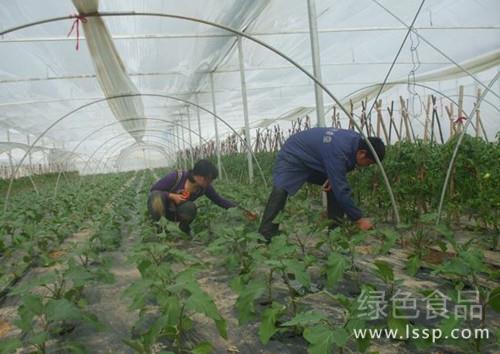
Pruning eggplants
Pruning: Generally, eggplants use the double-main-stem pruning method, that is, when the eggplant branches, select and keep two stems of consistent vigor as the main stems. Many vegetable growers are used to pinching the two fruiting main stems when they reach 1.5-1.8 m in height, relying mainly on side branches for fruit set. Experts, however, advocate continuous pinching and stem replacement for eggplants to ensure that fruiting does not skip a layer. This is generally done when the eggplant plant grows to 1.1 m in height, keeping a strong side branch below as the new fruiting main stem; the second pinching and stem replacement is done at a height of about 1.5 m. Through continuous pinching and stem replacement, you can not only dwarf the eggplant plant, but also effectively avoid the phenomenon of skipped fruiting layers.
Leaf removal: In the management of long eggplants in arched sheds, the leaf removal step is very important. Reasonable leaf removal not only reduces the plant's nutrient consumption, promotes eggplant coloring, but also avoids field shading and prevents diseases. However, in actual practice, many vegetable growers do not consider the growth stage and remove leaves blindly, which is very unfavorable to the growth of long eggplants.
Of course, removing diseased leaves and old leaves is worth advocating, but leaf removal should also be done in moderation. If the new leaves at the top have not yet fully developed, their ability to produce nutrients through the leaves is relatively low, and the growth of new leaves requires a large amount of nutrients, which must be supplied by other leaves; at this time, leaf removal is not advisable. The leaves in the middle and upper parts are fully developed and have high photosynthetic efficiency; the nutrients they produce must supply the growth of eggplant fruits, roots, and new leaves, and they are the main force of photosynthesis, so they should not be easily removed. Only the old leaves at the lower part, because of reduced chlorophyll, decreased enzyme activity, and insufficient light, produce limited nutrients, so removing them appropriately is beneficial to the eggplant plant.
Leaf removal can be carried out in stages; do not remove too many at once, which would leave the lower part of the eggplant plant almost completely bare. In the early fruiting stage, leaves should be removed even less; if leaves are to be removed, they should also be removed in order from bottom to top. Generally, no leaf removal is done before the main stems set fruit, because the lower leaves still play a role in producing nutrients to supply root growth. If the lower leaves have many insect eggs or severe yellowing, they should be removed in time.
In addition, if there is less fertilizer and water and growth is not vigorous, remove fewer leaves; in dry weather, remove fewer leaves. Generally, it is suitable to keep 2-3 leaves below the large fruits. If the temperature is relatively high, side branches sprout quickly and easily cause field shading. Therefore, remove the miscellaneous branches early, and side branches can be pinched early to prevent the side branches from growing too vigorously and affecting eggplant growth.