Winter pruning tips for grape fruiting canes: too early causes nutrient backflow, too late causes bleeding
The best time for winter pruning of grapes is from early November to mid-February of the following year, that is, 2-3 weeks after leaf fall to 3-4 weeks before spring bleeding occurs. Pruning too early will affect nutrient backflow; pruning too late easily causes bleeding. Bleeding will affect bud break and affect growth and fruiting. The winter pruning tips for grape fruiting canes are introduced as follows:
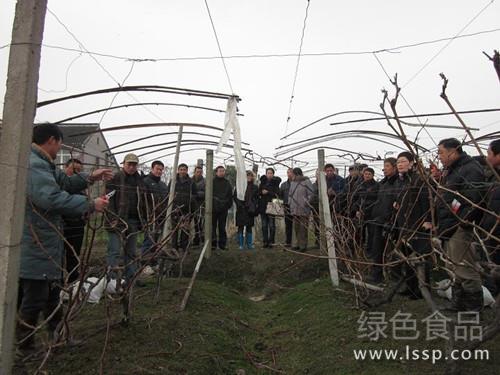
Grape winter pruning
I. Pruning and retention length:When pruning, generally select canes that are plump in growth, well matured, appropriately positioned, free of pests and diseases, and free of wounds, and cut 1-1.5 cm above a bud. The length of cane retained for pruning is based on the number of buds retained. It is generally divided into short-cane pruning (fruiting canes retain 1-4 nodes), medium-cane pruning (retain 5-7 nodes), long-cane pruning (retain more than 8 nodes), and mixed pruning (long-cane, medium-cane, and short-cane pruning). For specific pruning, differences in grape variety characteristics, cane growth vigor, and training methods should also be considered. For example, Muscat Hamburg, with short-cane pruning, has a high fruit-setting rate and relatively compact, uniform clusters, while Kyoho and Longyan grapes have higher flower-forming node positions and are suitable for pruning methods based mainly on medium and long canes.
Under the same conditions, any thick and strong cane with good nutritional status should be retained appropriately long; for weak canes, flower bud differentiation in the lower part is better, so appropriate short pruning is suitable; extension canes should be retained long, and renewal canes should be cut short; for trellis-trained multiple-main-cane fan-shaped pruning, long-cane, medium-cane pruning, or mixed pruning of long, medium, and short canes should be the main method; for dragon-trunk training, short-cane pruning should be the main method; in poor soil, areas with insufficient fertilizer and water, and arid areas, short-cane pruning should be the main method. In short, for a certain variety or for canes with different growth conditions on a certain plant, the pruning method should be flexible, or the mixed pruning method of long, medium, and short canes should be applied.
II. Number retained for pruning:In addition to clarifying the length retained for pruning in grape winter pruning, the number retained should also be considered. If the number of fruiting canes retained is small, the yield will be affected the following year due to insufficient cane volume; if too many are retained, the canes will be crowded, the load will be too large, light will be insufficient, flower and fruit drop will be serious, and overwintering and yield will be affected.
The length and number to be retained in winter pruning should be determined according to the variety, soil, fertilizer, and water conditions, the planned yield, the total number of fruiting canes to be retained in the whole orchard, and the number of fruiting canes to be retained per plant. In this way, yield can be ensured while also keeping the grape plants growing robustly and producing high yields year after year. In a generally high-yielding orchard, the number of canes is about 1000 canes per mu. Fruiting cane groups should be arranged evenly, attention should be paid to retaining renewal canes, and the double-cane renewal method or single-cane renewal method should be used to maintain the growth vigor of cane groups and rotate fruiting, so as to ensure stable and continuous yield.
III. Cut position and direction:The pith of grape fruiting canes is large and the tissue is relatively loose, so water evaporates easily. Therefore, when pruning, the cut should be 2-4 cm from the bud eye to prevent water evaporation at the bud eye site and an increase in dead and dried canes; the cut should be chosen as much as possible on the side opposite the cut bud.
IV. Post-pruning treatment:After grape winter pruning, in conjunction with trellis repair, the fruiting canes growing upward should be pulled into a horizontal direction, which can promote bud break at the base and the growth of new canes and more fruiting. The pruned dead branches, fallen leaves, rotten fruits, intercrops, etc. should be cleared out of the orchard and burned in a centralized manner.