How to prevent and control short and thick zucchini fruits that affect profits
At present, the formation of "short and thick fruits" is related to poor flower bud differentiation in early spring zucchini. Because in early spring the air temperature and soil temperature in the greenhouse are low, light is weak, ventilation and light transmission are poor, leaf photosynthesis is poor, and nutrient accumulation is low. In addition, the root function of zucchini weakens, and the absorption, transport, and utilization of fertilizer and water are hindered, thus causing poor flower bud differentiation in zucchini.
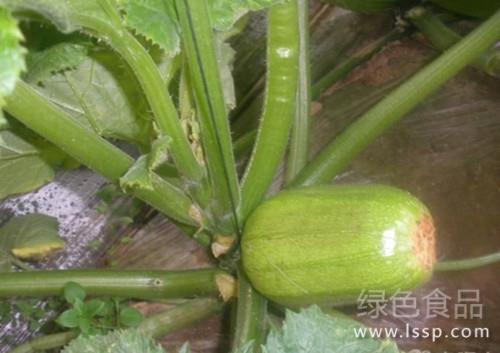
Short and thick zucchini fruits
In addition, during fruit development, if the concentration of the fruit-setting hormone is too high, or the fruit-setting hormone is applied too early, it leads to abnormal fruit development; keeping too many fruits and not thinning them causes insufficient nutrients in the fruits, restricting growth and development, and "short and thick fruits" are prone to occur; excessive water and fertilizer damage the roots, the ability to absorb water and fertilizer declines, and the aboveground supply of fertilizer and water to zucchini is insufficient, which also easily causes deformed fruits.
In production, vegetable growers can take the following corresponding measures according to the above causes:
1. Temperature management. In the early fruit-setting stage of zucchini, the suitable growth temperature is 18-22°C during the day and 8-10°C at night. If the daytime temperature is higher than 25°C, photosynthetic product accumulation is low but consumption is high, and zucchini is prone to excessive vegetative growth. Therefore, when planting autumn-delayed or overwintering zucchini while the temperature is still high, temperature control management should be carried out rather than raising the temperature to promote plant growth. Temperature control measures: strengthen ventilation, and do not close the front ventilation opening too early.
2. Avoid excessive soil moisture. After zucchini is planted and the seedlings have recovered, the main focus should be on controlling water to promote rooting. If the soil is not too dry, do not rush to water before fruiting. Of course, if zucchini lacks water and wilts severely, small amounts of water should be run through to ensure normal growth, and flood irrigation should not be used, as it causes excessive vegetative growth. At the same time, the water volume of the first irrigation after the root zucchini fruit sets should not be too large, otherwise it easily causes fruit abortion, which in turn leads to excessive vegetative growth. To promote reproductive growth smoothly, small-amount irrigation can be used.
3. Control nitrogen and supplement potassium in the later stage. After entering the fruit-setting stage, zucchini has a high potassium requirement, so when applying fertilizer with irrigation, attention should be paid to the use of high-potassium fertilizer, but nitrogen fertilizer must not be used excessively, so as not to cause excessive vegetative growth of the plants. Of course, if zucchini is planted too early and the early temperature is too high, hormone regulation can also be used, but not excessively, especially paclobutrazol, which should not be used continuously multiple times. Generally, 5-7 days after zucchini seedling recovery, spray with 15% paclobutrazol at 1500 times dilution, but do not spray only the growing point, to regulate plant growth.