Citrus trees severely damaged by extreme frost and freezing: how to remedy the damage after frost?
Recently, most regions of our country have suffered severe frost damage. To reduce losses and restore tree vigor early, the following recovery measures for citrus frost damage are provided for fruit growers' reference.
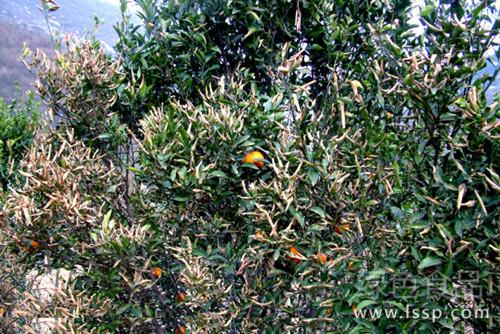
Citrus frost damage
1. Pruning according to the degree of citrus frost damage:
(1) Lightly frozen trees: Frostbitten, scorched leaves that have not fallen will continue to consume water and expand the frost-damaged area, so they should be knocked off as early as possible to prevent twigs from dying. Distinguish frost-damaged twigs and shoots; prune lightly and retain more leaves. One-year-old branches without leaves can be cut back to the two-year-old position; leafy branches should not be pruned for the time being, and green branches and leaves should be retained as much as possible.
(2) Moderately frozen trees: Where the boundary between dead and living frost-damaged branches is clear, renew and prune at the sprouting position. The degree of pruning varies from tree to tree; pruning should be carried out in stages, first light then heavy. Determine the sawing and cutting positions, starting from the overall shaping of the whole tree, with the aim of cultivating a new high-yielding tree canopy.
(3) Severely frozen trees: If the main branches are frozen to grades 3-5, skeleton renewal is needed; if frozen to grades 1-2, trunk truncation and renewal are needed.
(4) Frost-killed trees: Generally, for trees grafted on trifoliate orange rootstock, the root system does not die easily. The root suckers that sprout should be managed and strengthened in time, retaining 1-3 shoots for future grafting.
2. Fertilization :
After citrus is frozen, it will shed a large number of leaves, especially severely frozen trees. After pruning, few healthy leaves remain, the aboveground part has no sufficient nutrients to supply the underground part, and the root system has weak absorption capacity. When spring temperatures rise, the tree body sprouts a large number of buds and shoots; at this time nutrient supply will become imbalanced, which is unfavorable for the recovery of tree vigor. In view of the physiological changes in frost-damaged trees, fertilization should follow the principles of early application, frequent application, and light application. From February to March, mainly use quick-acting nitrogen fertilizer, applying no fewer than 3 times. For a 10-year-old citrus tree, apply no less than 100 grams of urea per tree each time, and mix with 10-15 kg of clear manure water, applying it in trenches dug around the tree disc. For frost-damaged trees that have not shed leaves, because frost damage reduces chlorophyll and because new shoots are often small and thin, resulting in poor photosynthesis, foliar fertilization can improve leaf quality and photosynthetic function. Foliar spraying of fertilizer can be carried out multiple times, preferably at intervals of 15-20 days, generally spraying 0.1% urea and 0.3-0.5% monopotassium phosphate. If frost-damaged trees show nutrient deficiencies, the deficient elements can be judged according to the leaves and supplemented in combination with foliar fertilization.
3. Strengthen tree protection and pest and disease control :
(1) Lightly frozen trees: After frost damage occurs, promptly spray 1:1:100 Bordeaux mixture or 800-1000 times thiophanate liquid, or 0.3 degree Baume lime sulfur mixture, to prevent leaves and shoots from becoming diseased.
(2) Treatment of pruning (sawing) cuts and frost wounds on moderately and severely frozen trees: The pruning (sawing) cuts should be trimmed into smooth slanted cuts, then disinfected with 75% alcohol or 0.1% potassium permanganate. After disinfection, the wounds should be coated with a protectant. The protectant can be prepared with butter or Vaseline mixed with 2% thiophanate.
(3) Control of resin disease and sunscald:
After citrus is frozen, it is prone to resin disease, and wounds are an important condition for its spread. Therefore, after freezing, in addition to paying attention to the disinfection and protective treatment of pruning (sawing) cuts and wounds, promptly lightly scrape and deeply cut the scattered disease spots appearing on branches and trunks, then apply 50% carbendazim 100 solution, or 50% thiophanate 200 times solution, or 1:1:10 Bordeaux paste, or 1:4 edible alkaline water, or water-based tar containing 2% carbendazim for coating treatment. For severely frozen trees, because of the large amount of pruning, few leaves, and exposed trunks, they are prone to sunscald bark cracking in summer and autumn. To prevent sunscald, brush the branches and trunks with whitewash 2-3 times from June to August. The whitewash is prepared with 5 parts lime, 0.5 part sulfur powder, 0.1 part salt, 0.1 part tung oil, and 20 parts water.
In addition, after frost-damaged citrus is pruned, it will sprout a large number of twigs and tender leaves. Attention should be paid to controlling aphids, whiteflies, mites, pierid butterflies, leafminers, and diseases such as sooty mold, anthracnose, and scab that harm tender shoots and tender leaves, so as to avoid uncontrolled damage.