Control methods for tomato black spot disease: brown spots that become sunken and then soft rot
Tomato black spot disease, also known as nail-head spot disease and finger spot disease, mainly affects the fruit, leaves and stems. When the fruit is infected, the lesions are grayish brown or brown, irregular to round in shape, slightly sunken, with a distinct margin; there may be one or several lesions of varying sizes, and the lesions can merge into large patches, with black mold-like growth on the surface; in the late stage of the disease, the affected fruit becomes soft and rots.
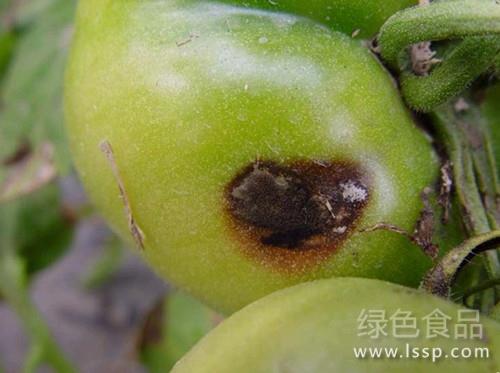
Tomato black spot disease
Disease pattern: The pathogen overwinters in the soil as mycelium or conidial clusters and conidia along with tomato diseased residues. In the spring of the following year, the conidia spread through air currents and cause primary infection and secondary infection. This fungus is weakly parasitic and has a wide host range; usually, tomato plants are attacked by this fungus only when they are weak in growth or the fruit has wounds. The pathogen prefers high temperature and high humidity; the most suitable temperature for disease development is 25-30°C, with relative humidity above 85%. The susceptible growth stage for tomato black spot disease is the tomato ripening stage. Fields that are low-lying, extensively managed, lacking fertilizer and water, and where tomato plants grow poorly have more severe disease; in years with high temperature and abundant rain, the disease is severe.
Control measures: For mild disease, spray with Aolike Sujing at 300-500 times dilution, applying once every 5-7 days; for severe disease, spray with Aolike Sujing at 300 times dilution, applying once every 3 days, with the number of sprays depending on the tomato condition. ① Seed disinfection: soak the seeds in warm water at 50°C for 30 minutes. ② Strengthen field management: try to prevent farm operations from damaging tomato plants; scientifically regulate fertilizer and water so that tomato plants grow steadily; after harvest, promptly clean the field, plow and sun the soil. ③ Chemical control: start spraying for protection from the green fruit stage of tomato, spraying once every 7-10 days, for 2-3 consecutive applications. The pesticide can be 75% chlorothalonil wettable powder at 600 times dilution, applied as a spray.