Strawberries show signs of fatigue after long-term continuous fruiting; how to prevent premature aging of the plants
When strawberries bear fruit continuously for a long time, nutrient consumption becomes excessive and they show varying degrees of fatigue. If management is not strengthened in time, the strawberry plants will age prematurely, affecting later fruiting and reducing yield.
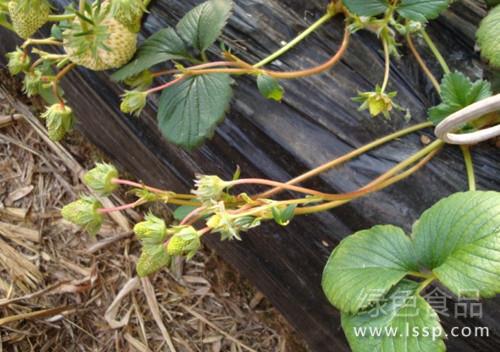
Strawberry premature aging
Main problems in the late growth stage of strawberries:
As temperatures rise, strawberry growth is affected by high temperatures. If old leaves, diseased leaves, diseased and damaged fruit, and leftover fruit stalks are not removed in time, they easily consume too many nutrients and affect air and light penetration; if ripe strawberries are not harvested in time, if there are too many flowers and fruit, if thinning is not done in time, and if fertilizer and water supply is imbalanced, premature aging is likely to occur; the number of bees in the greenhouse drops sharply, and if ventilation or supplementary pollination is neglected, deformed strawberries are likely to increase; pests and diseases such as aphids, red spider mites, thrips, powdery mildew, and gray mold easily make strawberries poor in market quality.
How to prevent premature aging of strawberries:
1. Strengthen plant management. Remove old leaves, diseased leaves, diseased and damaged fruit, leftover fruit stalks, excess side shoots, and runners in time. Be sure to carry out these operations on sunny days when the soil surface is dry to prevent wounds at the strawberry crown from becoming infected; do not water on the same day, to prevent excessive shading and leggy growth, and to enhance air and light penetration; harvest ripe strawberries in time to avoid excessive nutrient consumption; thin out high-order flowers, flower buds, small fruit, and deformed fruit in time.
2. Strengthen temperature management. Adjust the vents at any time according to the weather, and regulate the temperature inside the greenhouse reasonably. During the day, the temperature should be 20°C-28°C, and never allow high temperatures of 35°C or above. At night, prevent the temperature from falling below 5°C. During the day, the soil temperature should be 15°C-20°C. April weather is changeable, so watch out for a "late spring cold snap"; May weather becomes warmer, so strengthen cooling measures inside the greenhouse, pay attention to increasing ventilation, and lower the nighttime temperature as much as possible.
3. Strengthen fertilizer and water management. As light intensity increases and temperatures rise, strawberry plants need more water and nutrients, and because strawberries consumed too many nutrients during continuous fruiting in the earlier period, fertilizer and water management should be strengthened.
4. In principle, water and fertilize at intervals of 5-10 days. When watering, avoid flood irrigation; instead, water frequently in small amounts and keep the soil moist. Because the soil temperature rises, strawberry roots are highly active and their ability to absorb soil nutrients increases, so fertilization should be based on the actual situation, combining root-zone topdressing with foliar spraying; if soil fertility is good, mainly use foliar fertilizer. Combine root-zone topdressing with watering, and each root-zone topdressing amount should not be too large; according to the actual situation, the amount can be reduced by 30%-50% compared with the earlier period. Depending on the actual situation, foliar fertilizer can use potassium dihydrogen phosphate, amino acid foliar fertilizer, high-energy calcium foliar fertilizer, or other suitable micronutrient fertilizers.
5. Strengthen strawberry pollination measures. The number of bees in the greenhouse has already dropped sharply, so increase ventilation inside the greenhouse to enhance the strawberries' self-pollination ability, or use manual supplementary pollination.
6. Strengthen pest and disease control. Aphids, red spider mites, thrips, powdery mildew, gray mold, and other pests and diseases occur severely, so observe strawberry plants frequently so they can be found early and controlled in time. If the infestation is not severe, spray chemicals for control; if it is relatively severe, use smoke agents for control, or combine them with chemical spraying. Smoke agents should preferably be used in the evening, and note that the temperature inside a closed greenhouse should not be higher than 23°C to prevent phytotoxicity.