Key points of eggplant grafting seedling technology: avoid soil-borne diseases, high yield
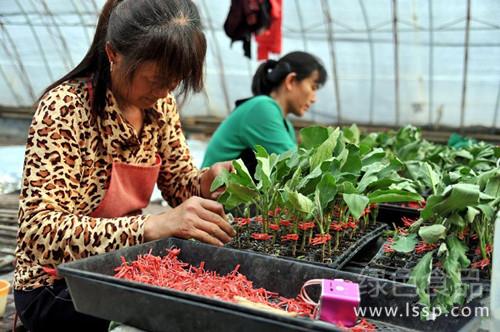
Eggplant grafting seedling raising
1. Seed treatment:
Use Torubamu eggplant (Solanum torvum) as the rootstock, with a seeding rate of 10—15 grams per mu. Because Torubamu eggplant seeds have strong dormancy and germinate and emerge slowly, before sowing, soak them in clean water for 7—8 hours so the seeds absorb enough water, then soak them in 100 mg/L gibberellin for 24 hours. After rinsing clean, put them in a gauze bag and carry out alternating-temperature germination. 25—30°C during the day, 15—20°C at night, with a day-night temperature difference of 15°C being suitable. Wash once a day, and sprouts can appear in 7—8 days.
For the scion seeds, the amount used per mu is 30—40 grams. Before sowing, the germination rate needs to be checked. Scion eggplant varieties need to be sown when the rootstock has two cotyledons emerging from the soil. Before sowing, use 55°C hot water for warm-water seed soaking, with a water amount 5 times the seed amount, and stir continuously, soak for 15 minutes, then soak in 25°C warm water for 8-12 hours. Wash off the seed coat mucus, and germinate at 28-30°C.
2. Sowing and seedling raising:
Torubamu eggplant is difficult to germinate and emerges unevenly, so it is not recommended to use plug trays or nutrient pots for seedling raising; instead, use trays for centralized broadcasting. Use high-quality peat as the rootstock seedling substrate. Before sowing, mix in an appropriate amount of microbial fertilizer and fungicide, and water and mix it moist. The humidity should be such that the substrate forms a ball when held in the hand, breaks apart when dropped on the ground, and has water in the finger gaps but not dripping. Spread a layer of substrate about 1cm thick on the bottom of the tray, evenly broadcast a layer of treated eggplant seeds, then cover with 1cm thick perlite, and spray 72.2% Previcur AS at 800 times dilution to prevent seedling-stage diseases. For winter seedling raising, plastic film needs to be covered, while in summer it is not needed. When the eggplant rootstock seedlings grow 3 true leaves, carry out seedling separation and move the small seedlings into plug trays. In July-August, use 50-cell plug trays; in October, use 72-cell plug trays.
For scion seedlings, the seeds can be sown directly into commercial seedling substrate plug trays, and the other operations are the same as for cultivating rootstock seedlings.
3. Grafting method:
When the rootstock grows 6-7 leaves, the stem diameter is 3-5 mm, and it has reached semi-lignification, this is the best period for grafting. When the scion grows 5-6 true leaves, grafting can be carried out. When using Torubamu as the rootstock, scion sowing should be delayed by about 25 days.
Before grafting, the rootstock seedlings should be kept in a slightly water-deficient state, which makes the sap at the cut viscous and helps the grafted seedlings survive. After grafting, water again, and the sap flow between the rootstock and scion speeds up, which helps the wound heal. In production, cleft grafting can be used.
Select rootstock and scion with similar stem thickness to pair. Cut the rootstock seedling horizontally at 5cm above the soil surface, leaving 2-3 leaves, then make a vertical downward cut 1cm deep in the middle of the cut surface. Leave 2-3 leaves on the scion seedling, cut off the lower part, and at 5cm from the lowest leaf, cut it into a wedge shape, with the wedge size matching the rootstock cut. After cutting, insert it immediately into the rootstock cut, taking care to align the epidermis of the rootstock and scion, then fix it with a grafting clip. When grafting, be accurate and quick; the faster the operation, the higher the survival rate of eggplant. The grafting blade must be sharp and clean; generally, each side of the blade is suitable for grafting about 150 eggplant plants.