Wine Grape Growing Season Pruning Techniques: Bud Removal, Shoot Thinning, Tendril Removal, and Old Leaf Removal
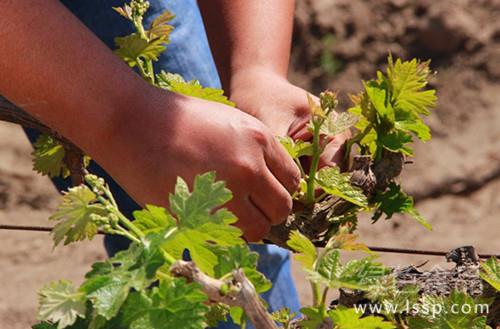
Grape Bud Removal
1. Bud removal. After grapes bud out in spring, remove the unwanted buds. The earlier the bud removal, the better the result. Mainly remove weak buds, crooked buds, and diseased or pest-damaged buds. When double buds appear, one of the relatively weaker ones can be removed. Latent buds sprouting on old canes should also be removed if they are not needed to fill space.
2. Sucker removal. As new shoots grow, suckers often emerge from the trunk and roots. The more suckers there are, the greater the pointless nutrient consumption, and the more unfavorable it is to new shoot growth and flower bud differentiation. Therefore, sucker removal is very important. In addition, suckers clustered at the base also encourage various soil-borne pathogens, so they should be removed early. This is generally done when the suckers have grown to 15-20 cm and have not yet become lignified.
3. Shoot thinning. When new shoots have grown to 15-20 cm and the flower clusters are visible, remove the excessive, overly dense vegetative shoots, fruiting shoots, and weak shoots, and keep an appropriate number of vigorous fruiting shoots and vegetative shoots, with a suitable ratio of fruiting shoots to vegetative shoots of 1:1. The earlier shoot thinning is completed, the more beneficial it is for saving the grapevine's nutrients. In areas with severe wind damage, the timing of shoot thinning can be appropriately delayed.
4. Tying. Begin when new shoots have grown to about 40 cm. For vines of moderate vigor, only 1 time is needed. For young vines and vigorous vines, carry it out in 2 stages according to the specific situation. The new shoot at the tip of a fruiting shoot can be tied in the direction of extension, and the remaining new shoots can be tied at nearly a right angle to the fruiting mother shoot. Tying should not be done too early, because young grape shoots are brittle and easily broken.
5. Pinching. Pinching fruiting shoots can promote flower cluster development and increase the fruit-setting rate. Pinching vegetative shoots can prevent excessive growth from affecting the growth of the fruiting mother shoot and can also help build the canopy. The timing and severity of pinching are related to the variety, vine vigor, and so on. For varieties with a low fruit-setting rate, such as Cabernet Gernischt, pinching should be done early and severely, generally 5-6 days before flowering, which helps prevent flower drop and fruit drop. For varieties with a high fruit-setting rate and compact clusters, such as Cabernet Sauvignon, pinching should be done at flowering or after flower drop, and the pinching should be somewhat less severe. Generally, fruiting shoots are often pinched at 5-6 leaves above the flower cluster, while vegetative shoots are pinched when the branch has 8-10 leaves and is fully extended.
6. Tendril removal. Grape tendrils are homologous with flower clusters, and their function is to twine around foreign objects to secure the canes. If tendrils are left untended and allowed to tangle randomly on the trellis, they cause inconvenience for tying new shoots and harvesting grapes, and also consume a large amount of nutrients. Throughout the growing season, tendrils on new shoots must be removed in a timely manner.
7. Handling lateral shoots. Grape lateral shoots grow in large numbers, often wasting nutrients, disrupting the vine form, and causing the trellis surface to become closed and shaded. Handling methods: (1) For lateral shoots on fruiting shoots, all those below the fruit cluster should be completely removed, while those above the fruit cluster position should be pinched leaving 1-2 leaves. For secondary lateral shoots growing from primary lateral shoots, except for the 2 at the tip of the branch, which are kept and pinched leaving 1-2 leaves, all other secondary lateral shoots should be removed as early as possible. (2) For lateral shoots on vegetative branches, generally keep 1-2 leaves and pinch, and the secondary lateral shoots that later emerge should also be repeatedly pinched leaving only 1-2 new leaves, so as to promote vigorous new shoot growth. Note that lateral shoot handling must not be too light, otherwise the branches on the trellis surface will become closed and shaded, affecting ventilation and light penetration; nor should it be too severe. Especially for Eurasian varieties such as Cabernet Gernischt, all lateral shoots must not be removed, in order to prevent forcing winter buds and affecting the next year's yield.
8. Removing old leaves. Remove the leaves around and below the fruit clusters so that the clusters receive sufficient sunlight, increase the grape's sugar content, anthocyanins, and tannins, reduce the malic acid content that is harmful to wine quality, and also promote berry ripening and reduce diseases such as acid rot. Old leaf removal is generally carried out 1 month before grape ripening, removing the l-5th leaves from the base of the new shoot and straightening the fruit clusters so that 75% of the clusters are exposed to sunlight. The timing must not be too early, otherwise it will affect grape yield and quality, especially reducing the grape's sugar content.