Artificial seedling-raising technique for northern sugarcane, which helps sugarcane mature early and achieve high yield
Growing sugarcane in the north differs from the south, as it requires artificial seedling-raising techniques. Raising seedlings not only saves sugarcane seed stock and ensures full, strong seedlings, but also advances and extends the sugarcane growing period, which helps with early maturity, color change, high yield and high sugar content. In Hebei and the Beijing-Tianjin region, seedling raising generally begins around the second lunar month, and after a 45-day seedling period, the plants are transplanted to the field. Based on their own conditions and sugarcane planting area, each locality adopts greenhouse, plastic tunnel, or large arch shed nutrient-pot seedling raising at the appropriate time. The operation methods are as follows:
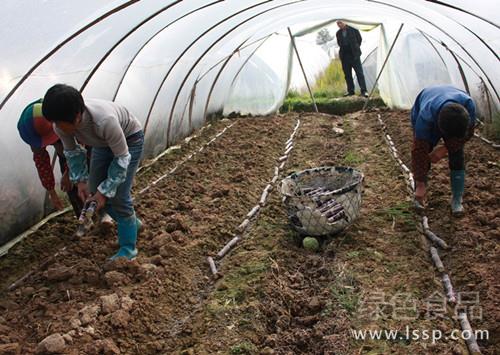
Sugarcane seedling raising
1. Greenhouse seedling raising:
1. Seedbed preparation: It is best to choose sandy loam that is sheltered from the wind, faces the sun, and is close to a water source and the transplanting site as the sugarcane seedbed. First water the seedbed to promote soil moisture, then deep plow and harrow repeatedly, breaking up and refining the soil. Then make beds, apply stove ash, plant ash, and sand, mix the soil and fertilizer evenly, and then spread a layer of fine soil. The bed width is determined by the seedling raising method, with convenience of management being best.
2. Seed cane treatment: Generally, sugarcane stalks used for breeding are not cut during seedling raising; they are cut when transplanted to the field. If the sugarcane buds are greatly damaged, they can be cut into two-bud or three-bud stem segments. Then soak them in 2% quicklime water for 10--14 hours or in a 400-fold solution of 50% amobam, then pile-store them to promote sprouting, and after the buds begin to sprout, plant them.
3. Placement of seed cane: Seed placement for seedling raising differs from direct sowing. For whole-plant seedling raising, the stalks should be placed neatly, with the bud positions facing sideways and laid flat. The seed canes should be spaced one finger apart. When placing the seed cane, use moist soil to secure both ends to prevent rolling. After arranging the seed canes, pour 1% lime water over them, then cover with 2 cm of soil; it does not need to be too thick.
4. Temperature regulation and water control: The shed temperature should be maintained at 20--30°C. If it exceeds 35°C, sprinkle water or uncover the film to cool it down; if it is below 15°C, pay attention to keeping warm and add straw curtains at night. Sugarcane seed germination is sensitive to moisture; if the water content in the sugarcane stalk is below 50%, the germination rate will decrease significantly. Keeping the soil moist at all times is especially important.
5. Timely stem cutting and transplanting: When sugarcane seedlings reach the 3--5 leaf stage, they can be lifted and the stems cut. If higher yield is required, seedlings can be raised until 6--7 leaves, and after the sugarcane seedlings tiller, transplant them to the field at the appropriate time.
2. Plastic large arch shed seedling raising: Because the air temperature, humidity, and soil temperature inside the shed are high, it can increase the early sprouting rate and emergence rate of sugarcane buds. The bed width is determined by the width of the shed film, generally 0.3—0.5 m narrower than the shed film.
2. Cut the seed cane into single-bud stem segments.
3. Seed placement: After filling with base fertilizer, place the sugarcane seedlings in the pots, then put the pots into the pre-dug seedling bed pits, then water, cover with 1--2 cm of fine soil, and finally cover with the shed film. After a seedling age of 45 days, remove the bags and transplant.