Eggplant leaves turn chlorotic and develop small brown spots; how to prevent and control leaf spot?
Eggplant leaf spot mainly damages the leaves. Initially, chlorotic pale to grayish-brown small spots appear, which later expand into round spots 3-8 mm in diameter with a dark brown to reddish-brown center and brown edges, on which clusters of small black dots form.
1. Pathogen characteristics:
Pycnidia, formed on the eggplant leaf surface, black, flattened spherical, embedded, 70-150 micrometers in diameter, with an ostiole 15-23 micrometers in diameter; conidia colorless, multicellular, thread-like or cylindrical, curved, 13-18 × 1-1.5 micrometers in size.
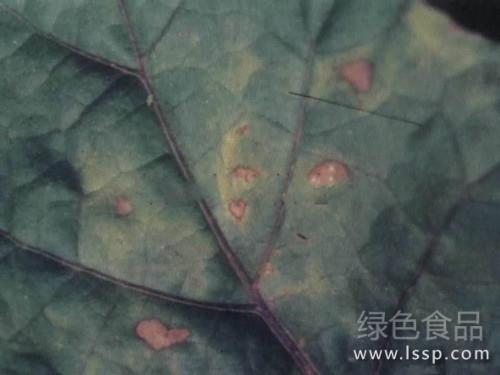
Eggplant leaf spot
2. Disease conditions:
The pathogen overwinters in the soil as mycelium and conidia with eggplant diseased residues. In the following spring, when conditions are suitable, it produces conidia, which spread by wind and rain, causing primary infection and secondary infection. In years or regions with warm, humid weather and many consecutive rainy days, the disease is severe.
3. Prevention and control methods
(1) Implement crop rotation of more than 2-3 years.
(2) Choose early-maturing varieties. Such as Jinan 94-1 Early Long Eggplant, Jifeng No. 3 Large Long Eggplant, Purple Long Eggplant 8591, etc.
(3) Collect seeds from disease-free eggplant plants. Before sowing, soak eggplant seeds in 55°C warm water for 15 minutes, or in 52°C warm water for 30 minutes, then cool with cold water, dry and sow; or mix 1 part each of 50% benomyl wettable powder and 50% thiram powder with 3 parts mud powder, and after mixing evenly, dress seeds at 0.1% of seed weight.
(4) Disinfect the seedbed; the seedbed soil must be replaced every year. At sowing, mix 10 grams of 50% carbendazim wettable powder per square meter, or 8-10 grams of 50% thiram powder, with 2 kg fine soil to make medicated soil. Spread 1/3 on the seedbed surface, then sow. After sowing, cover the remaining medicated soil over the eggplant seeds, that is, covering above and bedding below, with the seeds sandwiched in the medicated soil.
(5) Strengthen cultivation management and cultivate strong seedlings. Apply sufficient base fertilizer to promote early growth and early development, and advance the eggplant harvest period to before the disease epidemic season.
(6) Chemical control. After the eggplant sets fruit, begin spraying 75% chlorothalonil wettable powder 600 times solution, 40% metalaxyl-copper wettable powder 600-700 times solution, 58% metalaxyl?mancozeb wettable powder 500 times solution, 64% oxadixyl-mancozeb wettable powder 500 times solution, 70% phosphethyli- aluminum-mancozeb wettable powder 500 times solution, 50% benomyl wettable powder 1000 times solution, or 1:1:200 Bordeaux mixture. Depending on the weather and disease severity, apply about once every 10 days, for 2-3 consecutive applications. Stop using chlorothalonil 7 days before harvest and other fungicides 3 days before harvest.