Balcony potted blueberry growing techniques: add greenery and satisfy your cravings
If you love growing flowers and trees, you also need to learn how to care for them. Today I will teach you how to grow potted blueberries. Let's learn together.
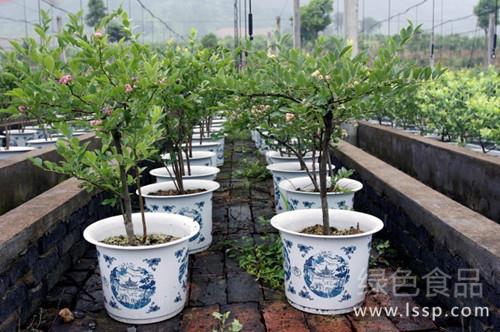
Potted blueberries
I. Time to buy potted blueberry seedlings and their management:
Potted blueberries can be planted at any time of year. The best time is from autumn to before bud break the following spring. During this period, blueberry seedlings are easy to transport, and management and planting are relatively simple. After autumn planting, the plants may produce a few flowers and a small amount of fruit the following year, and can flower and fruit normally in the third year. Full production begins after five years. For home potted blueberries, with proper management, the fruiting period can last 35 years.
II. Choosing potted blueberry varieties:
Rabbiteye blueberry, Sharpblue, and O'Neal do not set fruit well with self-pollination and require a pollinator variety to bear fruit, so these varieties are not easy choices. Lowbush types are only suitable for open-field planting in the north. All other varieties can be grown in pots.
III. Soil requirements:
Blueberries prefer acidic, soft, loose, well-aerated soil rich in organic matter. Generally, the soil pH should be 4.5-5.5, and the soil organic matter content should be 8%-12%. For home potting, you can buy humus soil and, depending on your conditions, add sphagnum peat moss or peat, wood shavings, crushed rotted pine bark, etc. Sulfur must be added once a month until the leaves show slight scorching. Apply acidic fertilizer. Key note: blueberries are calcifuge plants, so do not add bone meal to the soil.
IV. Containers:
Use well-aerated clay pots first, then sand pots, and plastic pots after that. Pottery or porcelain pots are not recommended. Because blueberries have fibrous, shallow roots, there is no need for a large pot, and deep pots should be avoided. For small seedlings, a 15 cm pot is recommended; for mature plants, a 25 cm pot is enough. Avoid using a large pot for small seedlings.
V. Climatic conditions:
An important factor in ensuring potted blueberries bear fruit is ensuring they experience winter dormancy at temperatures below 7.2°C. The lowest temperature they can tolerate depends on the variety. If grown as an ornamental flowering plant, low-temperature requirements may not be necessary.
Loosening the soil around blueberries
VI. Watering management:
Blueberry roots are shallowly distributed and quite sensitive to water. The potting soil should always be kept moist but not waterlogged, with differences between seasons. During the vegetative growth stage, the most suitable moisture conditions can be maintained throughout to promote strong blueberry growth. During the fruit development stage and before ripening, water supply should be appropriately reduced to prevent overly rapid vegetative growth from competing with the fruit for nutrients. After blueberries are harvested, restore the most suitable water supply to promote vegetative growth. From mid-autumn to late autumn, reduce water to help the plants enter dormancy in time. To maintain soil acidity, the recommended amount is: 3-5 degree vinegar, applied 500 ml each month, with half a tablespoon of vinegar added.
VII. Fertilization:
Blueberries are oligotrophic plants. Compared with other fruit trees, their internal levels of nitrogen, phosphorus, potassium, calcium, and magnesium are very low. Because of this characteristic, blueberry fertilization must especially avoid excess to prevent fertilizer injury. When blueberries are planted, organic matter has already been mixed into the soil, so blueberry fertilization mainly refers to topdressing. Potted blueberries are suitable for phosphorus pentoxide and ammonium sulfate. Excessive fertilization can easily cause damage to the plant or even death. Therefore, the amount of fertilizer must be chosen carefully, depending on soil fertility and plant nutrition. Better too little than too much! In addition, blueberries cannot be given nitrate fertilizers, such as ammonium nitrate, potassium nitrate, etc.
VIII. Pruning and shaping potted blueberries:
Pruning periods can be divided into winter and summer, or strictly speaking, the dormant period and the growing season.
As long as they are managed properly, growing a potted blueberry full of flowers and loaded with fruit is not difficult!