Master the plastic-film mulching cultivation technique for spring potatoes for high yield and good returns
When cultivating spring potatoes, choosing good varieties, applying sufficient fertilizer, sowing at the right time, and controlling pests and diseases can yield 2000 kg per mu, with a marketable rate as high as over 80%.
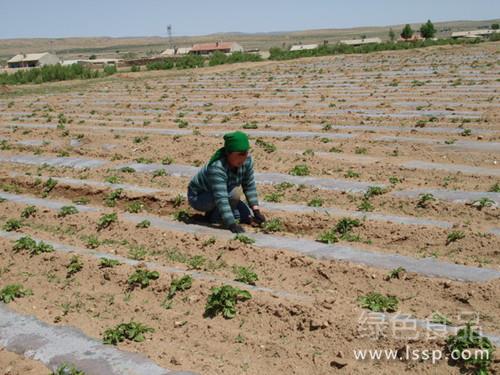
Plastic-film mulching cultivation of potatoes
Careful selection of varieties:Use virus-free seed potatoes, such as Zhengshu No. 6, Dongnong 303, Jinyan No. 8, Zhongshu No. 3 and other early-maturing, strongly disease-resistant varieties.
Choosing a good preceding crop:Choose deep soil that is loose, fertile, and slightly acidic sandy loam for planting potatoes. The preceding crop should be Liliaceae or Cucurbitaceae vegetables, rice, soybean, etc.; try to avoid plots where solanaceous fruits and peanuts were previously planted, so as to reduce damage from scab, wart disease, wireworms, and white grubs.
Apply more fertilizer:For every 1000 kg of potatoes produced, 5 kg of pure nitrogen, 2 kg of phosphorus pentoxide, and 11 kg of potassium oxide are required. For a yield of more than 2000 kg per mu, each mu requires 2000 kg of decomposed organic fertilizer, 10 kg of urea, 70-80 kg of sulfur-based compound fertilizer, and 15-20 kg of potassium sulfate. For plastic-film mulching, the above fertilizers can be applied as a base fertilizer all at once.
Cutting seed potatoes and sprouting:20—25 days before sowing, cut the seed potatoes into pieces weighing about 40 g, each with 1-2 buds, and soak them in a 500-fold solution of 25% carbendazim for 10 minutes. Remove and sun-dry them. After the cut surfaces are air-dried, pile the seed pieces in a sheltered, sunny place to sprout, with a pile height of 60-80 cm, cover with 10 cm of rice straw, then cover with a layer of plastic film and seal the edges tightly. Sow when the sprouts are 0.5-1 cm long.
Sow early at the right time:For plastic-film mulching cultivation, sow from late January to early February; for open-field cultivation, sowing can be postponed to mid-February. 10 days before sowing, scatter the organic fertilizer, urea, and potassium fertilizer, then plow, then apply the compound fertilizer and make ridges with a ridge spacing of 85-90 cm and a ridge height of 30 cm. Sow on a sunny day at a depth of more than 10 cm, using 180-200 kg of seed per mu, with about 4500 basic plants. After sowing, use 100 mL of 50% acetochlor or 100 mL of 33% pendimethalin per mu, add 50 kg of water, and spray for chemical weed control; cover with plastic film 30 minutes after spraying.
Proper pruning:After full emergence, keep one strong main stem per plant to grow, except for the plants on both sides of missing hills, so as to increase yield and raise the marketable rate.
Pest and disease control:The main diseases of spring potatoes are late blight, blackleg, scab, etc.; disease-resistant varieties should be selected and crop rotation should be used. The main pests are white grubs, cutworms, aphids, etc. To control white grubs, scatter 1.8 kg of 3% Dichongshaxing per mu before sowing; before budding in early April, use 300 mL of 50% phoxim plus 1500-2000 kg of water per mu to spot-irrigate each plant. To control aphids, from late April to early May, use 15 g of 10% imidacloprid plus 50 kg of water per mu for spraying, and apply the pesticide once more after 7-10 days.