How to prevent and control cucumber leaves with uneven, bumpy blisters accompanied by water-soaked spots
On the upper surface of cucumber leaves, small light-green blisters of about 5 mm appear, after which their number increases, and they rarely occur on the underside. This is cucumber blister disease, which some also describe as looking like “toad skin”; it occurs mainly in overwintering and early-spring greenhouses and glasshouses, and is a physiological disease. When it occurs, the leaf surface is uneven, and the sunken areas appear white and blanket-like, with nothing attached when scraped. No pathogen is produced on the raised parts of the leaf; the tops of the blisters are initially chlorotic green, gradually fading to pale yellow, greyish white or yellowish brown. Sometimes water-soaked spots (physiological water congestion) appear on the tops of the blisters.
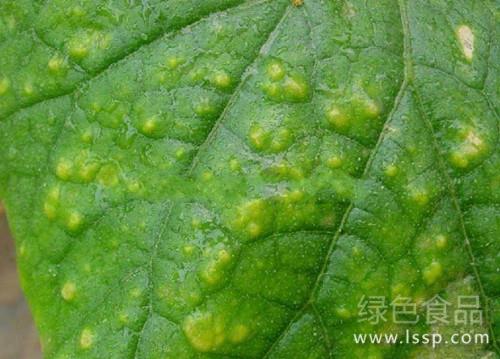
Cucumber blister disease
I. Causes:
(1) Formation mechanism: it is generally regarded as the result of photosynthetic products of cucumber being deposited in the leaves, and is related to low temperature and insufficient light. Of the photosynthetic products in cucumber leaves, generally only 15-20% can be transported out during the day, and the remaining 80-85% needs to be transported and distributed to the growing point, fruit, roots and other parts in the first half of the night. The transport speed of the products is closely related to temperature: to complete all transport and distribution, at 20℃ it takes 2 hours; at 18℃, 4 hours; at 16℃, 6 hours; below 16℃, transport is very slow, or even stops. If the greenhouse has poor heat retention, or the spring greenhouse is closed late in the evening, the temperature in the first half of the night is low and cannot meet the needs of product transport, so part or all of the products remain in the leaves, which is called deposition. Such daily deposition causes the mesophyll between the veins to bulge.
(2) Epidemic pattern: in the early stage of cucumber growth, the temperature is low, cloudy and rainy days last long, and light is weak; after the beginning of spring, when the weather suddenly clears, the temperature rises quickly, sunshine is abundant and the amount of watering increases, blister disease is easily induced. In addition, it is also related to variety resistance and the environment; cucumber varieties that are not adapted to low temperature and insufficient light are prone to this disease.
II. Prevention methods:
(1) Choose varieties resistant to low temperature and tolerant of low light and weak light. (2) Strengthen heating and heat preservation measures; in the afternoon, when the temperature inside the greenhouse drops to about 20℃, cover with straw mats or close up to retain heat, and keep the soil temperature at 15-18℃ to prevent low-temperature freezing injury. (3) Use anti-drip film, and frequently clean the plastic film and glass on the greenhouse; when necessary, supplement light artificially and apply carbon dioxide. (4) Water reasonably. On cloudy days with low temperature, watering should not be reduced; on sunny days when the temperature rises, avoid heavy watering. Watering should avoid drastic fluctuations. Generally, watering should be done in the morning on sunny days. (5) Strengthen cultivation management to improve the stress resistance of cucumbers. (6) When transplanting cucumbers, increase the application of base fertilizer and pay attention to combining multiple elements; according to temperature changes, preserve and increase heat in good time. Prevent and control pests and diseases in good time.