Carrot forking hurts profits: find the cause and control it scientifically
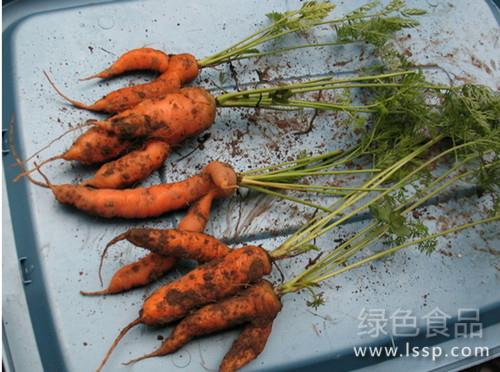
Carrot forking
1. Causes of forking. The main causes of forking in the carrot's fleshy root are as follows:
1) Seed quality. Old carrot seeds have weak viability and germinate poorly, which affects the growth of the tip of the young root; in some cases the radicle is damaged, making forking likely. Carrot seeds harvested in the rainy season are prone to poor embryo development or embryo-less seeds because of poor pollination; sowing such seeds makes the fleshy root prone to forking.
2) Soil causes. Hard objects in the soil such as gravel, bricks, tiles and tree roots obstruct the growth of the carrot's main root and cause forking; plots with a shallow, hard plow layer also tend to block main root growth, prompting adventitious roots to develop and producing forks.
3) Fertilization causes. Excessive or uneven fertilization may cause the soil EC value at the tip of the carrot root to be too high. The main root tip is affected by the high concentration of soil ions, which prompts adventitious root growth and causes forking.
4) Improper management. Unreasonable watering: if drought occurs during the fleshy root swelling stage of the carrot and no water is given, the soil becomes too hard and the main root cannot grow downward, making forking likely. This cause of forking is especially obvious when watering does not soak through or on higher ground.
5) Damage by underground pests. Underground pests such as mole crickets and white grubs bite and feed on the carrot's main root, damaging it, prompting adventitious root growth and causing forking.
2. Methods to prevent carrot forking :
1) Choose high-quality, high-yield varieties whose fleshy roots are straight and resistant to forking, such as Japanese New Kuroda Gosun Ninjin and Hongyu Gosun.
2) When buying seed, choose fresh, plump, fully developed carrot seeds.
3) The plot must be deeply plowed and finely harrowed; deep plowing should be no less than 25-30cm, and fine harrowing lengthwise and crosswise should be done 2-3 times, striving for fine soil; when preparing the land, do not miss any plowing or harrowing, especially at the edges and corners of the field. At the same time, pick out debris such as broken bricks, tiles, stones and tree roots from the field.
4) Water reasonably at the key stages. When watering, make sure it soaks through, and be sure not to give “running horse water”.
5) Organic fertilizer must be fully decomposed. When fertilizing, strive to spread it evenly.
6) Pay attention to controlling underground pests to avoid damage to the carrots.