Key field management points for spring-planted potatoes: cultivation and weeding, topdressing and watering, controlling excessive vine growth
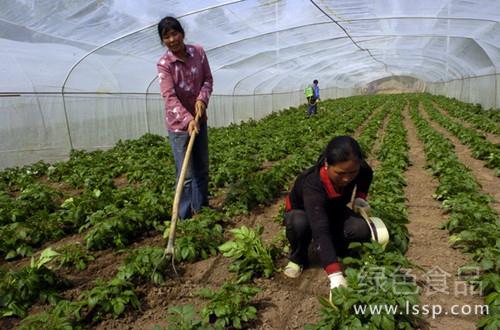
Potato weeding
1. Cultivation, weeding and hilling:
The timing, frequency and method of cultivation and hilling for potatoes depend on the local cropping system, climate and soil conditions. In the northern single-cropping region, 12—15 days after spring sowing, lightly rake the ridge surface to cover the soil by 3—5cm, which can conserve soil moisture, raise temperature, eliminate weeds and promote early emergence. Cultivation, weeding and hilling are generally carried out 2 to 3 times: the first after full emergence, but when spring drought is severe, shallow cultivation and delayed hilling may be appropriate to reduce soil moisture evaporation; the second at the bud stage, with cultivation and thicker hilling to promote stolon formation; the last before ridge closing, with shallow cultivation and high hilling to prevent tubers from being exposed on the surface and turning green from sun exposure. Ultimately the ridge should reach 15—20cm in height, formed into wide and high large ridges. For dry land in the single-cropping potato region, hilling should begin as soon as the rainy season starts; for plastic film-mulched potatoes, after emergence, promptly break the film to release the seedlings and seal the openings tightly with soil; when the seedlings are about 10cm tall, remove the film and carry out cultivation and hilling.
Herbicides such as DuPont Baocheng herbicide can also be used for weeding, controlling broadleaf weeds, grass weeds and sedges before and after potato emergence. Herbicides should be applied early. The best application period is the 2 to 4 leaf stage of weeds, with 5 to 6 grams of pesticide per mu. First prepare the agent into a mother solution, dissolve it thoroughly, then pour it into the sprayer, then add neutral washing powder at 0.2% of the spray volume, and spray evenly.
2. Topdressing:
Potatoes are heavy feeders with high yields and are sensitive to fertilizer; timely and appropriate topdressing can increase yield. Topdressing should follow the fertilizer requirements of potatoes and the condition of the seedlings, and should be done early rather than late, and preferably less rather than more. It is generally applied before flowering; early-maturing varieties are topdressed at the seedling stage, while mid-to-late-maturing varieties are topdressed at the bud stage. Mainly nitrogen and potassium fertilizers are applied as topdressing, with phosphorus and micronutrient fertilizers supplemented; nitrogen fertilizer should not be applied after flowering. Topdressing can be done by furrow application, hole application or foliar spraying, and soil topdressing is combined with cultivation and irrigation. Generally after the second cultivation and before the first irrigation, the first topdressing is carried out. For early-maturing varieties, topdressing begins when the seedlings are 10cm tall; for mid-to-late-maturing varieties, heavy fertilization is needed at the bud and flowering stages; if potatoes show premature senescence in the late growth stage, a 0.2% potassium dihydrogen phosphate solution can be sprayed. When drought is severe, chemical fertilizer amounts should be reduced to avoid root burn or loss of fertilizer efficiency. The topdressing amount varies with soil fertility, planting density and variety type, and must be determined according to specific conditions.
3. Watering:
Although potatoes are more drought-tolerant than other crops, they are sensitive to water and require large amounts of water throughout the growing period. At the current level, furrow irrigation is better for watering, but the soil should be loosened in time to increase soil aeration. It is advisable to irrigate to 1/2 of the ridge height, and never more than 2/3 of the ridge height; avoid flood irrigation at all costs. Current mechanized sprinkler irrigation technology can save water resources and improve water use efficiency, and is unlikely to cause soil compaction, but water droplets can form on the leaf surface and easily trigger the spread of diseases such as late blight, so fungicides should be sprayed promptly after irrigation. Drip irrigation makes good use of limited water sources, reduces soil erosion and evaporation, and can also adjust the amount of chemical fertilizer according to the needs of different growth stages of potatoes, dissolving it in water and supplying it directly to the roots, but the equipment is relatively expensive and can easily cause soil salinization, so it is mostly used in greenhouses or net house production.
4. Controlling excessive vine growth:
If potato planting density is high, water and fertilizer management is improper, or excessive watering or one-sided nitrogen application occurs, rampant growth is likely. The main manifestations are excessively vigorous stem and leaf growth, elongated stem nodes, thin and weak stems, thin and large leaves, yellow-green leaf color, and continued rapid stem and leaf growth during the tuber-setting stage; in severe cases the plants lodge, causing tuber formation and enlargement to be hindered, reducing tuber number and weight, and some remain green and delay maturity. Excessive vine growth in potatoes is highly harmful: it wastes water and fertilizer, reduces yield, and can also induce diseases. In field management, in addition to controlling water and fertilizer, plant growth inhibitors are commonly used to regulate aboveground and underground growth and promote tuber setting. Those with good application results include paclobutrazol and tuber expansion agents.