Spring planting of walnuts should be early rather than late: key points for spring planting of walnut seedlings
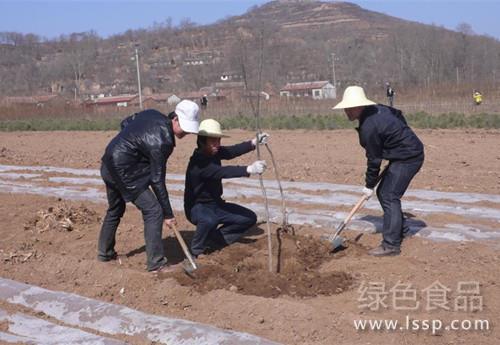
Spring-planted walnut seedlings
1. Planting time: Spring planting should be early rather than late, otherwise the soil moisture is poor, which is unfavorable for seedling recovery. Therefore, walnut seedlings can be planted after the soil thaws until late March; the earlier the better.
2. Seedling selection: The quality of walnut seedlings determines the success of orchard establishment and the level of benefits. Therefore, choose 2-3 year old grafted walnut strong seedlings with excellent and pure varieties, well-developed taproots, complete lateral roots, no pests or diseases, strong branching ability, easy flower formation, strong stress resistance, plant height above 1 m, basal diameter greater than 1 cm, and relatively many fibrous roots.
3. Seedling treatment before planting: First prune the seedling root system, cut a fresh cross-section on the taproot, cut off rotten roots, and grade according to seedling size, tying them into bundles in fixed quantities; each bundle should be immediately placed in clean water to soak, with the water depth preferably higher than the root system and lower than the graft union, soaking for more than 12 hours so the root system absorbs enough water. After the walnut seedlings have absorbed enough water, place them in a 2000-fold ABT rooting powder solution and soak for 5-20 minutes, which can improve the survival rate, then place them in a 0.5% carbendazim solution for quick dip disinfection. Finally, dip the roots in mud slurry to prevent the root system from drying out in the wind.
4. Planting: Before planting, first prepare the land, dig large holes 1 m square, keep topsoil and subsoil separate, and when backfilling, put topsoil in first, then subsoil. When planting, take out only as many seedlings as needed; generally the plant and row spacing is 4×5 m, 33 plants per mu, with pollinator trees arranged at 1:10, and each hole is given a mixture of farmyard manure and topsoil.
When planting, add water first, preferably more rather than less, then fill in the mixture of topsoil and farmyard manure, then place the sapling. When placing the seedling, note that the graft union faces north (because trees have phototropism, the graft union facing north can adjust the crown distribution, and moreover the north often has northwest winds, to prevent wind breakage), and it must be kept upright, then fill with soil; when filling soil, fill from the surrounding area toward the middle, keeping it even. After the soil is filled, gently lift the walnut seedling so it reaches its previous position; it should not be too shallow or too deep. Too deep easily causes poor growth and slow seedling recovery, affecting the survival rate; too shallow easily causes water loss, resulting in dead seedlings.
5. Management after planting: After the seedlings are planted, to prevent soil moisture loss, the tree should be covered with plastic film. The plastic film specification is 90 cm2; first level the ground, and when laying the plastic film, two people cooperate, with the center of the plastic film passing through the center of the walnut seedling, press it flat and lay it well, and use fine soil to press the surroundings and the root crown of the seedling firmly and tightly, to prevent the plastic film from being blown open by wind and causing water loss. For young walnut trees after field planting, carry out trunk heading, heading at a plump bud 60—80 cm high. After heading, cover the trunk with a special bag to prevent damage from leaf-eating insects such as scarab beetles; after the temperature rises, gradually remove the wind protection and take off the bag. After the young trees sprout, strengthen management of soil, fertilizer, water, pests, and diseases.