Diagnosing Wheat Nutrient Deficiency by Looking at the Seedlings and Treating the Cause
The growth and development of wheat requires a variety of nutrient elements. If a certain nutrient is lacking, the external morphology of the wheat seedlings will show corresponding characteristics. Therefore, in production, based on the external symptoms of the wheat seedlings, one can diagnose the problem by looking at the seedlings and treat the cause accordingly.
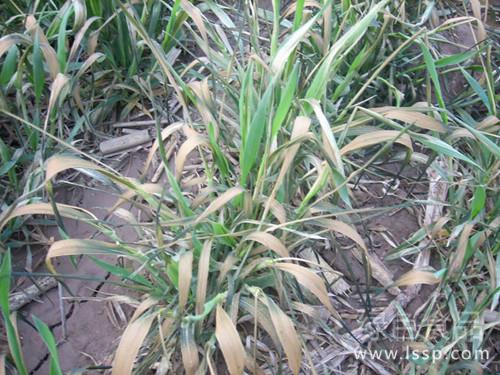
Wheat Nutrient Deficiency Symptoms
Nitrogen deficiency:Wheat growth and development requires a large amount of nitrogen. When nitrogen is insufficient, wheat grows poorly, with short stems, few tillers, and thin, weak seedlings that stand upright, with narrow and short leaves; the leaf color at the stem base turns yellow, leaf tips dry up, and this spreads to the upper leaves, finally causing the lower old leaves to die prematurely. Nitrogen-deficient wheat seedlings have poor root growth, with a small root mass that is thin and long, and small heads with few grains. Generally, nitrogen deficiency is prone to occur in barren soil. Remedial measures: apply 7~8 kg of urea or 20 kg of ammonium bicarbonate or 600~700 kg of human and animal manure diluted with water per mu. A 1~2% urea solution can also be used for foliar spraying.
Phosphorus deficiency:When wheat seedlings are deficient in phosphorus, root growth and development are restricted, with few secondary roots, the plant is thin and small, with few tillers, the leaf color is dark green, lacking luster, slightly purple, and the leaf sheath is noticeably purple. The symptoms develop from the leaf tip toward the base and from old leaves to young leaves. Cold resistance is poor, and seedlings are prone to dying during overwintering. Heading and flowering are delayed, affecting pollen formation and fertilization, and grain filling is abnormal; this leads to a decrease in thousand-grain weight, poor quality, and low yield. Remedial measures: First, apply 25~30 kg of superphosphate diluted with water per mu; second, spray 150~200 g of potassium dihydrogen nitrate diluted in 75 kg of water per mu on the leaves.
Potassium deficiency:When wheat is deficient in potassium, growth is slow, stems are short, leaves are dark green or blue-green, soft and drooping, leaf tips and edges turn yellow and withered, then turn brown, while the leaf veins remain green, and the lower old leaves scorch and dry up; in severe cases, the entire leaf dies. Root growth is poor, prone to rotting, the plant wilts, and it is prone to premature aging and lodging. Heads are small with few grains, grains are not plump, maturity is early, quality is poor, and yield is low. Remedial measures: (1) Apply 7~10 kg of potassium chloride per mu as a top dressing. (2) Broadcast 100 kg of plant ash per mu. (3) Foliar fertilizer spray: use 150~200 g of potassium dihydrogen phosphate diluted with water per mu for spraying, continuously spraying 2~3 times.
Zinc deficiency:When wheat seedlings are deficient in zinc, little leaf disease occurs, leaf margins are twisted or shrunken, the areas along both sides of the leaf veins turn from green to yellow and whitish, while the edges remain green, forming striped bands of alternating yellow, white, and green. Heading is delayed, and heads are small with few grains. Remedial measures: Spray 0.3~0.4% zinc sulfate solution on the leaves, once every 5~7 days, continuously spraying 2~3 times.
Boron deficiency:The most typical symptom of boron deficiency in wheat is “heading without grain filling”. The growth period is delayed, sometimes heading and tillering occur simultaneously, and the leaf sheath sometimes turns purple-brown. Remedial measures: Apply 150~200 g of borax per mu mixed with fertilizers such as nitrogen, phosphorus, and potassium and diluted with water as a top dressing, or use 50~100 g per mu diluted in 50~60 kg of water for foliar spraying.
Calcium deficiency:When wheat is deficient in calcium, the growing points and stem tips die, wheat becomes short or clustered, young leaves often do not unfold, the root system is short with many branches and few root hairs, and the root tips secrete a transparent mucus that appears spherical and adheres to the root tips. Calcium-deficient leaves also turn yellow, starting from the young leaves. Remedial measures: Broadcast 50~70 kg of lime per mu.