High-quality, high-yield cultivation techniques for water bamboo (wild rice stem): hitting the market during the off-season for vegetables brings good returns
Water bamboo is white and tender, contains a large amount of amino acids, tastes delicious, is rich in nutrients and has excellent flavor. The harvest period of water bamboo is May to June and September to October, which coincides with the off-season for vegetables, so the returns are considerable. Below, the editor introduces the high-quality, high-yield cultivation techniques for water bamboo.
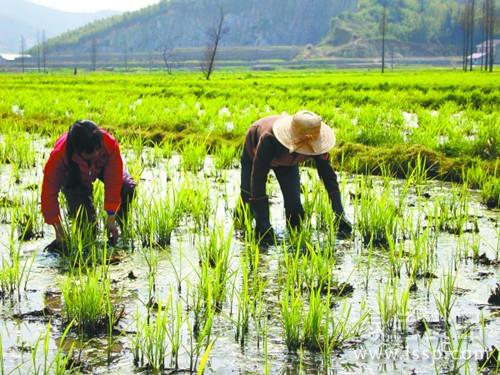
Water bamboo planting
(1) Soil cultivation: Choose a field that is sheltered from the wind and facing the sun, convenient for both drainage and irrigation, and with loose, fertile soil for planting water bamboo. Prepare the land before planting; it should be water-cultivated and water-leveled. Before land preparation, apply 3500-4000 kg of green manure or barnyard manure, or 3000-4000 kg of human feces as base fertilizer, break it up and level it, achieving rotten mud, sufficient fertilizer and level ground, and tamp the field ridges solidly to strictly prevent water and fertilizer leakage. After exposing to the sun for several days, irrigate with 3 cm of shallow water, enough, in preparation for planting.
(2) Seed selection and planting: 6-7 days before harvesting the autumn water bamboo, select seed clumps from the clumps; they must conform to the characteristics of the original variety, with relatively short plants, growth vigor not excessive, the height of the leaves clasping the stem roughly the same, but the last 1-2 central leaves obviously shortened and contracted, such as when the leaf sheath and the water bamboo white eye are tightly contracted together.
Water bamboo can be planted in spring or autumn. Regardless of single-crop or double-crop water bamboo late-maturing varieties, in the Yangtze River basin in April to May, when the mother clump's sprouts are 33-40 cm high, with 3-4 true leaves, dig up the water bamboo clumps, use a sharp knife along the tillering points, split them into several small clumps, each clump with stolons and 4-6 strong tillers, cut off the leaves, retain the leaf sheath at 16-26 cm long, to reduce water evaporation and help improve the survival rate; dig, divide and plant as you go.
Autumn planting: Dig up old clumps after sprouting at the Beginning of Spring, cut each tiller into 8-10, and plant temporarily in lotus root fields or fertile muddy fields for seedling cultivation, often maintaining a water depth of 3 cm, until July to August when each hole already has more than 10 tillers, then divide and plant once more.
In July to August, when entering the white bamboo formation stage, remove the weaker tillers, leaving one water bamboo per 10 square cm; by early August, pick off yellow leaves 2-3 times, tread the yellow leaves into the soil as fertilizer, and press a piece of mud in the middle of the water bamboo clump, so that the plants spread out toward the four sides of the clump, facilitating ventilation and reducing disease.
(3) Fertilizer and water management: Water bamboo has a long growth period, many tillers and a large fertilizer uptake; planted once, harvested multiple times, so base fertilizer and topdressing must both be emphasized. Topdressing is applied 4-5 times in total, according to the principle of "promote-control-promote." 7-10 days after planting, apply the seedling-promoting fertilizer, applying 500-1000 kg of clear manure water per mu to promote seedling growth. Half a month later, apply 1000-1500 kg of clear manure water or 10-15 kg of urea per mu, after which stop fertilizing to avoid excessive growth. Thereafter it enters the tillering stage; from late July to early September, when the new water bamboo tillers enter the white bamboo formation stage and the bamboo shoots begin to swell, apply 3000-4000 kg of concentrated manure water and 20-25 kg of urea per mu to promote the swelling of the bamboo shoots; afterwards, the 4th to 6th fertilizations can be handled as appropriate.
The water level in the water bamboo field should be flexibly controlled according to the growth and development characteristics of water bamboo, following the principle of "shallow-deep-shallow" (shallow water for planting, deep water for establishing the plants, shallow water for tillering). Before sprouting, irrigate with 2-3 cm of shallow water to promote sprouting; after planting, maintain a water depth of 5-8 cm to promote tillering and rooting; at the late tillering stage, deepen to 10-14 cm to control ineffective tillering. During the high-temperature period of July to August, the water depth should be maintained at 13-17 cm, and the water should be changed frequently to lower the temperature and reduce pests and diseases. From the white bamboo formation stage to 6-7 days before harvest, according to the growth of the main stem water bamboo, irrigate the fetus-nourishing water well. Initially maintain about 15 cm, then gradually deepen to 23-27 cm, so that the entire water bamboo is submerged in water, but do not exceed the "water bamboo white eye." At the late white bamboo formation stage, gradually irrigate shallow water to 3-7 cm. After harvesting the autumn water bamboo, maintain shallow water of 2-3 cm to prevent the roots from freezing and rotting.
(4) Pest and disease control: During the white bamboo formation stage, there are the large rice borer, the striped rice borer and the long green planthopper. During the young larval stage of the pests, use 100 g of 50% fenitrothion emulsifiable concentrate plus 75-100 kg of water per mu for splashing irrigation, or use 90% trichlorfon and 40% dimethoate 1000-fold solution; after peeling off the old leaves, pour the solution into the heart of each plant. After the Beginning of Autumn, when aphids, leafhoppers and thrips occur, use 40% dimethoate emulsion 1000-fold, or 200-300 g of 10% leafhopper powder wettable powder plus 50-75 kg of water for spraying; for water bamboo rust, spray with 1:800-fold sodium rust preparation.