Peach tree leaves developing brown spots, drying up, dropping off and perforating? Control methods for shot hole disease
Peach shot hole disease commonly includes fungal shot hole disease, bacterial shot hole disease and brown spot shot hole disease. In recent years it has shown a trend of increasing severity, with bacterial shot hole disease being the most serious. Peach shot hole disease causes massive leaf drop, and in severe cases twigs die back, yields decrease, and flower bud formation is affected.
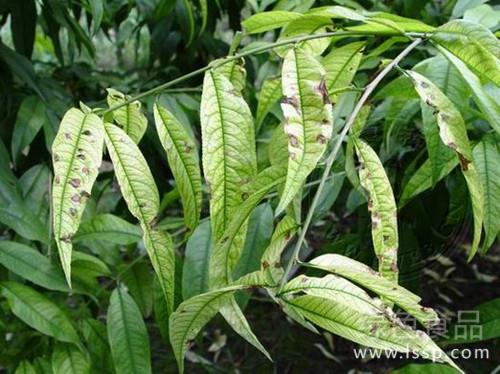
Peach shot hole disease
I. Damage symptoms:
1. Bacterial shot hole disease. It mainly damages leaves, and also damages peach fruit and twigs. When leaves are affected, small water-soaked spots appear first, later developing into dark brown lesions surrounded by a pale yellow halo; cracks form at the edges, and after the lesions fall off, holes form, or part of the lesion remains connected to the leaf. The lesions are about 2 mm. When fruit is affected, the lesions are dark brown, slightly sunken, with water-soaked edges. When humid, bacterial ooze appears on the lesions; when dry, cracks form. Diseased branches show two types of lesions, spring and summer. Spring cankers occur on branches grown in the previous summer; after the pathogen invades, dark brown small blisters form on the branches the following spring, and after enlargement they cause branch dieback. Summer cankers mostly occur on current-year shoots in late summer, forming dark purple spots centred on lenticels, which after enlargement become slightly sunken, darker in colour, with water-soaked outer edges.
2. Brown spot shot hole disease. It damages leaves, twigs and fruit. When leaves are affected, round or irregular lesions appear on both sides, with concentric rings at the edges and a purple outer margin; later a greyish-brown mould layer forms on the lesions, and the lesions are 1-4 mm in diameter. The centre of the lesion dries up and falls off, forming a hole. When new shoots and fruit are affected, the lesions resemble those on leaves, and a greyish-brown mould layer also forms.
II. Control methods:
1. Apply more organic fertiliser to strengthen the trees and improve disease resistance. For heavy, compacted soil, apply more horse manure or other organic fertiliser to improve the soil.
2. Prune rationally so that the peach tree canopy has good ventilation and light penetration; at the same time, thoroughly remove dead branches, diseased leaves and fallen fruit, and burn or bury them deeply in a centralised way to eliminate overwintering sources of inoculum.
3. Strictly control the number of irrigations and the amount of water applied, and ventilate promptly. During the rainy season, pay attention to drainage.
4. Spray control: if shot hole disease was severe the previous year, after nectarine leaves unfold, spray 45% amobam 800-fold solution, or 72% agricultural streptomycin 2500-fold solution, or streptomycin sulfate 3500-fold solution or xinzhiromycin 3500-fold solution, or 50% thiram 500-fold solution, or 65% zineb 500-fold solution, or 70% mancozeb 500-fold solution, generally once every 10-15 days, for a total of 3-4 sprays. In addition, spraying zinc sulfate lime solution at 1:4:240 (zinc sulfate:slaked lime:water) also has a good control effect on bacterial shot hole disease, but it sometimes easily causes phytotoxicity, so a small-plot trial should be carried out before use.
5. Do not apply nitrogen fertiliser alone; apply more phosphorus and potassium fertiliser, and grow strong seedlings to improve the disease resistance of peach trees. Irrigate moderately; do not water on cloudy or rainy days or in the afternoon, and prevent frost damage.