Early spring pepper planting enters a critical period, and management points must be grasped well
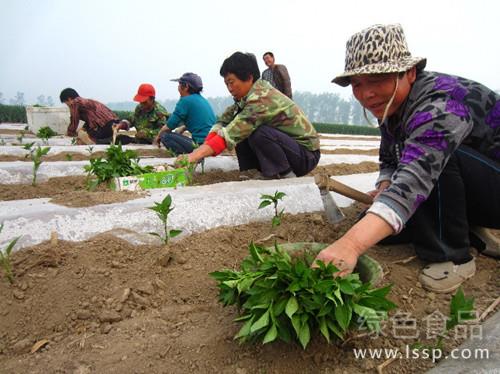
Pepper transplanting
Sowing period selection: sow in mid-February, transplant in mid-April, using 30-50 grams of seed per mu. Sow 10 grams of pepper seed per sq m of seedbed, requiring 5 sq m per mu. Nutrient soil preparation follows the principles of no pollution, no pests or diseases, rich nutrition, and loose air permeability; use 1/3 baked and sifted soil thoroughly mixed with 1/3 decomposed pig manure residue and 1/3 humus soil. First sun-dry the seeds for 2-3 days, then soak them in 55°C warm water for 15 minutes, wash them clean with clear water, and place them at 25°C-30°C to germinate for 5-8 days; sow when about 70% of the pepper seeds have cracked open. Mix the pepper seeds evenly with plant ash or dry sand or fine soil, sow them on the seedling-raising plot, taking care to sow thinly, cover with disinfected sifted fine soil 1—2 cm, lightly sprinkle a layer of seed-settling water, cover the ground with plastic film, and build an arched shed, then enter seedling-stage management.
Seedling-stage management: For temperature management, maintain the daytime temperature at 20°C-30°C and the nighttime temperature at about 13°C-18°C, high first and low later. Prick out seedlings in time; when the seedlings are 30-35 days old and have 3-4 true leaves, prick them out at a spacing of 7-8 cm. On sunny days, cover the small arched shed with a shade net. Pricking-out bed management: during the seedling recovery period, ensure the ground temperature reaches 18°C-20°C and the daytime temperature is 25°C, strengthen covering, and increase the relative air humidity. Pepper seedling-stage pests and diseases mainly involve controlling damping-off and Rhizoctonia solani seedling blight; when a small number of diseased plants are found, pull them out in time and spray with 75% "Chlorothalonil" (tetrachloroisophthalonitrile) 600-fold solution once every 7-10 days, for 2 consecutive sprays.
Harden the seedlings 7 days before transplanting, lowering the nighttime temperature to 13°C-15°C, controlling water, and gradually increasing ventilation. Transplanting site selection: peppers are unsuitable for continuous cropping, so choose fields where Solanaceae crops have not been grown within 3-5 years, rich in organic matter, with deep soil layers, water- and fertilizer-retentive, capable of both irrigation and drainage, without water accumulation in the rainy season, and without water shortage in drought. Generally, 50-60 days after sowing, when the seedlings have 8-10 true leaves, is the best transplanting period. Apply sufficient high-quality base fertilizer, applying 3000-4000 kg of farmyard manure per mu; to improve fertilizer efficiency, apply the base fertilizer in concentrated holes or furrows, not spread evenly over the whole field. Fertilizer should not be applied too shallowly or too deeply, with 10-15 cm being best. Make beds and lay film, with bed height 10-20 cm and bed width 100-120 cm. When the soil temperature at a depth of 10 cm in the plow layer reaches 10°C-20°C, transplanting can begin. Pay attention to crop rotation; 50 kg of quicklime can be used per mu for disinfection. 1-2 days before transplanting, spray the seedling plot once with "Dimethoate" (thiophosphate) 1500-fold plus "Chlorothalonil" 500-fold to avoid seedlings carrying aphids, and also water with dilute decomposed human waste. Transplanting should be carried out on cloudy days or on sunny afternoons; during transplanting, carry as much soil as possible and injure the roots as little as possible to improve the survival rate. The planting specification is beds raised at 1.3 m including furrows, with plant spacing 30 cm and row spacing 50 cm, planting about 3300-3500 pepper plants per mu, transplanting single plants, and watering thoroughly with transplanting water.