Purple cabbage is more nutritious and has better market prospects; a detailed explanation of the key cultivation techniques
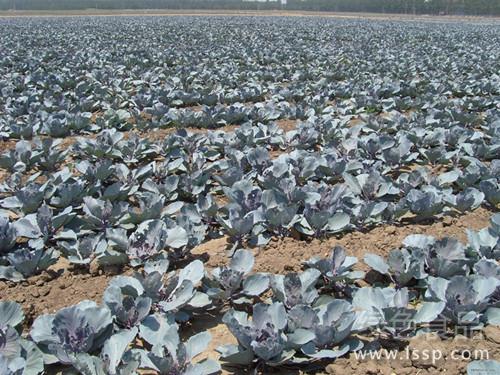
Purple cabbage
Seedling raising and sowing: The seedling age of purple cabbage is about 70-80 days in spring and about 40 days in summer. Seedling raising methods: seedbed seedling raising, seedling tray raising, and nutrient pot seedling raising. For both seedbed seedling raising and pricking out, sufficient organic fertilizer must be applied. The seedbed should be finely prepared and the bed surface leveled well. For seedling tray raising and nutrient pot pricking out, a soilless seedling raising method using a mixture of vermiculite, perlite, peat soil, etc. as the nutrient soil can be adopted. For the seedbed, choose a plot with loose and fertile soil, high terrain, convenient drainage and irrigation, and a previous crop that was not a cruciferous crop.
Sowing period: It should be determined according to the characteristics of the purple cabbage variety and the harvest time. Generally, dry seeds are broadcast, with a seeding rate of 50-100 grams per mu. Before sowing, water the nutrient soil in the seedbed or seedling tray thoroughly. After the water seeps in, mix the dry seeds with an equal amount of fine sand and broadcast evenly. After sowing, cover with 1.5 cm of soil, then cover with film. After sowing, pay attention to heat preservation to promote strong seedlings and early growth. Keep the daytime temperature at 25°C and the nighttime temperature at 15°C. After the seedlings emerge completely, lower the daytime temperature to 20°C and the nighttime temperature to 10°C to prevent the hypocotyl of the seedlings from elongating. In spring, the temperature is low and evaporation is small. For seedbed seedling raising, generally after watering enough bottom water before sowing, there is basically no need to water again, so as to avoid lowering the soil temperature, but the light duration should be extended and the light conditions improved.
Land preparation and planting: Purple cabbage has a strong ability to absorb nutrients and is a fertilizer-loving crop, so the land should be deeply plowed and sufficient base fertilizer applied. Apply 5000 kg of organic fertilizer, 25-30 kg of phosphate fertilizer, 30-40 kg of urea, and 20-30 kg of potassium fertilizer per mu. After evenly plowing and harrowing with the soil, prepare the land and make beds, forming beds 1-1.5 m wide. The calcium content in purple cabbage is second only to nitrogen. If calcium is deficient, tipburn will occur, so calcium fertilizer should also be supplemented appropriately.
Plant when the seedlings have 6-8 true leaves, and planting should be carried out when the soil temperature in the cultivation field is not lower than 8°C. This is because under low-temperature conditions, purple cabbage easily passes through the vernalization stage, causing premature bolting. Although purple cabbage has moderate winter hardiness, it will also bolt prematurely under prolonged low temperatures. In spring, choose a mildly warm morning for planting. When planting, the seedlings should be kept with soil to reduce root damage. For spring planting with water, the amount of water should not be too large, so as to help raise the soil temperature, promote rapid seedling recovery, and enhance seedling resistance.