Early spring wheat rolling has many benefits: preserving soil moisture, raising temperature, and resisting drought
Proper rolling of wheat in early spring can preserve soil moisture, raise temperature and resist drought. Let us now take a closer look at the knowledge related to wheat rolling!
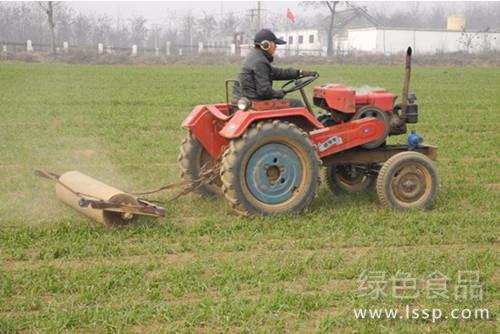
Wheat rolling
Rolling wheat in early spring can control excessive vigor and turn it into strong growth, and can raise and preserve soil moisture while saving water. In wheat fields with excessive growth, rolling several times from the green-up stage to the standing-up stage can inhibit above-ground growth of wheat, control excessive vigor and turn it into strong growth, and prevent lodging. In wheat fields where the soil was prepared roughly at autumn sowing and there are many clods, roll promptly after the soil thaws in early spring to settle the soil, close cracks, reduce water evaporation, and prevent cold air from intruding near the wheat tillering nodes and freezing the wheat seedlings. In dry wheat fields without irrigation conditions, rolling after the soil thaws in early spring can move moisture from the lower soil layers upward, playing a role in raising soil moisture, preserving soil moisture and resisting drought. Rolling is carried out in combination with hoeing, generally rolling first and hoeing afterward, so as to achieve a loose top and firm bottom, raise soil moisture, preserve soil moisture and raise temperature.
Rolling after sowing: Rolling after sowing can crush clods, settle the soil, increase soil compactness, connect soil capillaries, and make water in the lower soil layers rise, which helps preserve and raise soil moisture. It can also make wheat seeds and soil combine more closely, promote wheat seedling rooting, advance emergence by 1-2 days, and increase the average number of tillers per plant by 0.4-0.6.
Rolling in the early tillering stage: Rolling wheat seedlings at this stage subjects them to a certain amount of pressure and exercise, activates their internal growth capacity, inhibits main stem growth, promotes early tillering, narrows the gap between large and small tillers, keeps seedlings strong, makes growth uniform, and increases the rate of tillers forming spikes.
Rolling in the overwintering stage: Wheat seedlings consume much nutrition at this stage, and rolling can be combined with hoeing and covering with soil to improve the cold resistance of wheat seedlings. Rolling at this stage should be carried out after the peak tillering stage, when tillers are differentiating in two directions and the internodes have not yet been pushed out of the ground. It can temporarily inhibit the main stem and large tillers of wheat seedlings, making them grow stocky and thick, help field ventilation and light penetration, enhance the cold tolerance, freezing resistance and drought resistance of the wheat field, and strive for strong stems and large spikes and increased grain weight.
Rolling in the standing-up stage: In wheat fields with excessive growth, rolling before and after standing-up can inhibit excessively rapid above-ground growth, avoid premature jointing, promote tillers to form spikes, accelerate the death of small tillers, increase the spike-forming rate and uniformity of wheat, promote thick and strong straw, and enhance lodging resistance.