Water availability affects celery yield: high-yield cultivation techniques for celery
Celery has a shallow root system with weak absorption capacity; its roots are mainly distributed in the soil layer 10--20cm below ground, with a horizontal spread of about 30cm. Therefore, during the vigorous growth period of celery, whether sufficient water can be supplied in time will directly affect the yield and quality of celery.
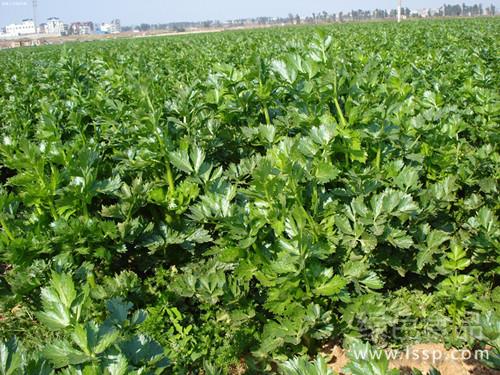
Celery
Celery prefers a cool and moist environment, with an optimal growth temperature of 15°C--20°C. It can still grow at high temperatures above 30°C, but growth is poor and quality is inferior above 26°C; however, seedlings are tolerant of high temperatures. Young celery plants with 4--5 leaves can endure low temperatures of -10—-12°C; mature plants can withstand short-term low temperatures of -8—-10°C. Celery is a green-plant vernalization plant; seedlings with 3--4 leaves can pass through the vernalization stage in 15--20 days at low temperatures of 2°C--5°C. After passing through the vernalization stage, celery bolts and produces flowers and seeds under long-day and high-temperature conditions. Celery requires moderate light intensity; strong light inhibits vertical growth and promotes horizontal growth. Under strong light, the fiber content in the leaf stalks increases and quality declines.
Celery seedlings grow slowly, and the seedling stage is relatively long, while the root system has weak absorption capacity, so water requirements are strict. After celery enters the slow growth stage, it needs less water than seedlings. After celery enters the vigorous growth stage, the soil surface is covered with white fibrous roots, and water demand is greatest at this time.
Celery's mineral requirements: in the early growth stage, nitrogen and phosphorus are primary; in the late growth stage, nitrogen and potassium are primary. Celery has a high demand for boron and calcium. When boron is deficient, leaf stalks tend to crack; when calcium is deficient, black heart disease easily occurs. Celery can be cultivated in all four seasons. However, before cultivation, strong seedlings generally need to be raised, with a seeding rate of 30--50 grams per mu.
Seedling raising. If raising seedlings at low temperatures, seeds generally need to be soaked and pre-germinated: soak seeds in clean water for 12--24 hours, with a germination temperature of 15--20°C. After sowing, cover with 1cm of fine sand or 0.5cm of fine moist soil, then cover with film to retain moisture and heat, requiring a soil temperature of 15°C--20°C. If sowing at high temperatures, dry seeds are generally sown directly for seedling raising; after sowing, immediately cover with thin straw curtains or other mulch for shading, and gradually reduce shading after seedlings emerge. After emergence, seedlings have poor water absorption capacity, so water frequently with small amounts. When 2--3 leaves have formed, thin the seedlings. After that, keep the bed surface alternately dry and moist. When 3 leaves and 1 heart or 4 leaves and 1 heart have formed, transplant.
Transplanting. Transplanting density depends on the size of the celery variety itself and the required commercial size. Generally, for single plant weight of 700--1000 grams, plant and row spacing should be 25--35cm; for single plant weight of 300--600 grams, plant and row spacing should be 17--25cm; for single plant weight of 250--300 grams, plant and row spacing should be 13--17cm.
Management after transplanting. Daytime temperature is generally 15°C--20°C, nighttime 5°C--10°C, and strive to keep nighttime temperature no lower than 5°C. When celery seedlings are about 15cm tall and begin to approach row closure, start topdressing and watering, applying 15--20 kg of ammonium nitrate or 25--30 kg of ammonium sulfate per mu each time. After that, water once every 3--5 days and topdress once every 15--20 days. Harvest can be done after 50--60 days.