Detailed Explanation of the Softening Cultivation Method for Green Garlic Sprouts: Good Benefits for Flavor and Color
Green garlic sprouts have a delicious flavor and serve both to season and to add color. There are two ways to cultivate green garlic sprouts: one is without earthing up, so the false stem is exposed to light; the other is with earthing up, so the false stem is shaded and softened, making the false stem white and crisp-tender and the leaves bright green and vivid. The following introduces the softening cultivation method for green garlic sprouts.
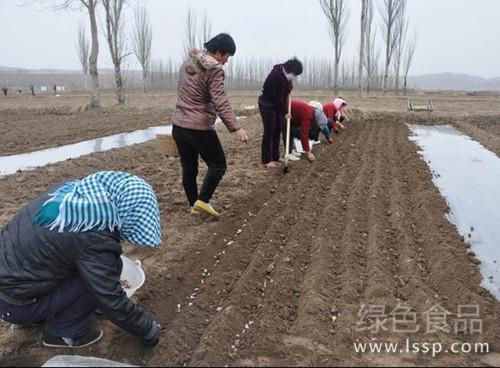
Sowing Garlic Sprouts
1. Cultivation season: In southern regions, softened cultivation of green garlic sprouts can be carried out from late August to March of the following year, sowing at any time and harvesting successively until May. In the north, open-field cultivation is from mid-to-late August to late September, with harvest in mid-to-late November. For protected cultivation, sowing is carried out successively from early October to March of the following year, with harvests continuing until May of the following year.
The time required from sowing to harvest for garlic sprouts depends on temperature conditions. When the daily average temperature is 13-20°C, it takes 45-50 days from sowing to harvest. If the temperature is 7-13°C, it takes 75-80 days; at 0-7°C, the seedlings stop growing but are not damaged by freezing. Because garlic sprouts do not have high temperature requirements, simple protective facilities with ordinary insulation performance are mostly used in cultivation, such as windbreak sunken beds, small arch sheds, and plastic greenhouses. They can also be cultivated along unused paths at the north wall base of solar greenhouses, or on household windowsills.
2. Variety selection: Various garlic varieties can be used to cultivate softened green garlic sprouts, and suitable varieties exist in each region. In the past, small-clove varieties such as Gouya garlic were mostly used, which could save garlic seed and lower costs, but the garlic sprouts were slender, low-yielding, and of poor quality. At present, large-clove varieties are mostly used instead in various regions. Large-clove varieties require a larger amount of seed and cost slightly more, but the yield is very high, the quality is good, and growth is vigorous. There are specialized varieties for cultivating garlic sprouts, such as Guangxi Quanzhou Meat Garlic. This garlic has a mild-tasting but plump clove, and the garlic sprouts produced are thick and high-yielding. For early autumn cultivation, varieties with a short dormancy period should be used so that they sprout early after sowing. In the Shandong region, purple-skinned garlic is preferable.
3. Sowing: Whether in open field or protected cultivation, make flat beds 1.5-1.7 m wide. Apply 45,000 kg of decomposed organic fertilizer per hectare in the bed and shallowly turn the soil 10 cm. Garlic seed treatment is the same as for autumn-sowing cultivation. Seed cloves can be sown with the skin on, or soaked overnight in clean water and then sown after the outer skin is removed; after peeling, seedlings emerge faster and more uniformly. When sowing, place the garlic seed cloves vertically and densely in the bed. After sowing, cover with 3 cm of soil, water thoroughly, and then scatter another 1-2 cm of soil.
4. Earthing up for softening: Proper earthing up can increase the length of the false stem of green garlic sprouts, improve product quality, and soften the false stem. When the garlic sprouts have basically emerged completely and the leaves have not yet unfolded, water thoroughly once. After the water seeps down, cover with a layer of sandy soil, horse manure, or chopped grass about 5 cm thick. If the garlic sprouts grow vigorously and grow above the covering soil, scatter another layer of covering soil to ensure the false stem of the garlic sprouts reaches 10-15 cm.
Watering Garlic Sprouts
5. Field management: Softened green garlic sprouts mainly rely on nutrients accumulated in the seed cloves for growth. If the seedling bed has sufficient base fertilizer, topdressing during the growing period may be unnecessary. In protected facilities, the temperature is lower and water evaporation is less, so after watering before the first earthing up, generally no further watering is needed. In open-field cultivation, multiple waterings are required from sowing to harvest. Before emergence, water lightly and frequently, which can both lower soil temperature and keep the soil moist, while also promoting root development of the garlic sprouts and earlier emergence. After the garlic sprouts have emerged completely, urea can be applied with irrigation water at 150 kg per hectare. 15-20 days before harvest, 1 application of urea may also be topdressed. For green garlic sprouts overwintering in the open field, wintering water should be applied before winter.
6. Temperature management: In protected cultivation, temperature management must be appropriate. Before emergence, maintain 20-25°C inside the protected facility. During the growing period after emergence, keep daytime temperatures below 20°C; if it exceeds 20°C, ventilate to cool it down; at night, do not let it fall below 5°C. 4-5 days before harvest, lower the temperature to about 15°C during the day. If the temperature is too high during the growth period of garlic sprouts, they are prone to excessive vegetative growth and lodging, affecting product quality. If the temperature is too low, growth slows, affecting the time to market. Therefore, in late autumn and early winter, when the outside temperature is relatively high, ventilation should be strengthened to cool the facility. In deep winter, attention should be paid to sealing the plastic film tightly and adding straw mats for insulation.
7. Harvest: The standard for high-quality softened green garlic sprouts: the false stem is long and thick, the plants are relatively uniform in size, the leaves are tender, there is no excessive vegetative growth, and there are no withered yellow leaves or dried leaf tips. At harvest, they can be pulled up together with the seed cloves, tied into bundles, washed, and marketed. They can also be cut with a knife about 1 cm above the ground. When cutting, do not damage the garlic cloves. After new leaves grow, topdress and water again to promote the growth of the garlic sprouts and facilitate a second cutting. At the third harvest, pull them up by the roots and market them.