Three-step improvement for mature walnut trees: trunk heading and renewal, grafting for variety replacement, and shape training
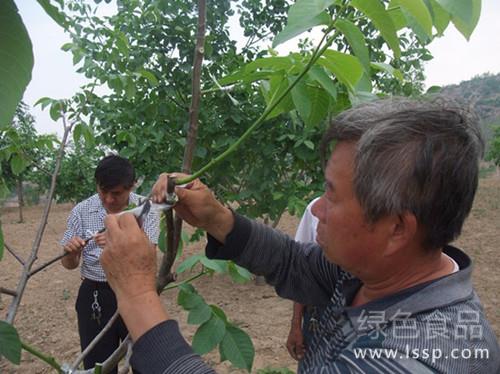
Walnut tree improvement
Step one: trunk heading and renewal.
For large walnut trees that need to be converted to superior varieties, design the tree shape according to the specific situation. Following the designed tree shape, remove useless large branches from the base, and head the needed ones leaving stubs to stimulate latent buds to sprout. According to the training plan, select and retain permanent extension buds and temporary reserve buds.
Early April, before budbreak, is the best time for trunk heading. At this stage the tree has little bleeding, and the stimulus is strong, which favors wound healing and latent bud sprouting. The number of stub levels left after heading should be simple rather than complex. For a medium-sized large tree, leave the central leader stub 60 cm above the first tier of scaffold branches, and leave the first-tier main branches stubbed at 50cm. For a tall tree, work above the second tier of scaffold branches: leave the central leader stub 30cm, the second-tier scaffold branches stubbed at 20 cm, and the first-tier scaffold branches stubbed at 50cm. All cut surfaces should be scraped smooth and wrapped with plastic film to prevent the cut surface from drying and cracking and to promote healing.
After trunk heading, select the stock buds promptly. That is, leave 1 bud on each side of the upper part of the central leader; on the second-tier scaffold branch stubs, leave 1 extension bud at the upper end on the back and 1 reserve bud on the side; on the first-tier scaffold branch stubs, leave 1 extension bud at the upper end on the back, 1 lateral branch bud on one side, and 1 reserve bud on the other side. Especially in positions where branches are missing, be sure to leave a bud to fill the gap. Remove the remaining useless buds to reduce nutrient consumption. When the selected extension buds and reserve buds grow to 20cm, pinch off the tips so they can be used for grafting.
Step two: grafting for variety replacement.
Choose superior walnut varieties according to local conditions, and carry out grafting in July of the same year as trunk heading and renewal, or in June of the following year. Grafting methods: those skilled in operation can use square patch budding; those less skilled can use I-shaped budding. It is best to use two woodworking blades for cutting plywood, with a rectangular wooden block 3 cm wide and 2cm thick clamped in between, to make a self-made double-edged budding knife; this is both fast and ensures that the "opening of the graft union and cutting of the bud" are kept at a consistent distance above and below. Whichever grafting method is used, all retained stock branches should be grafted in one go, and the graft union must be on the side facing the direction in which the grafted branch needs to extend. After grafting, wrap tightly and completely with a transparent plastic strip wider than the graft union, which can promote survival.
Strengthen management after grafting. For those grafted in July of the same year, prevent the grafted buds from sprouting. After grafting, only pinch out the stock's growing tip, do not touch other branches and leaves, do not cut the stock, and do not remove the wrapping film; when buds sprout the following spring, then cut the stock and remove the wrapping film. For those grafted in June of the following year, promote first and then control, striving to give the grafted branches both growth and the ability to overwinter safely. Therefore, after grafting, leave 3 compound leaves above the graft union and cut off the stock tip. Ten days later, check survival, cut off the compound leaves, and promptly remove other sprouts to concentrate nutrients and promote the grafted buds to sprout. When the grafted buds emerge through the film and grow to 10cm, cut off the stock stem and remove the wrapping film to promote rapid growth of the grafted branches; when they grow to late August, pinch off the tips to control height growth and strengthen the filling out and development of the lower part. In addition, although walnut has strong healing ability and the graft union joins firmly, the new grafted branches and leaves are heavier than those of other fruit trees, so on mountaintops and at wind gaps they still need to be tied to stakes for support to prevent wind breakage.
Step three: positioning and shaping.
In the third year after trunk heading and renewal, the new grafted branches grow to about 80cm, and early-bearing varieties begin to set fruit. Positioning and shaping should be done in good time to promote rapid recovery of the canopy and yield. Specific method: after leaf expansion in spring, select a robust upright extension shoot on the central leader and cut it back leaving 80cm to promote the second or third tier of scaffold branches, and bend another branch to horizontal as a auxiliary fruiting branch. Cut back the extension shoot of the second-tier main branch leaving 60cm to promote a second lateral branch. Do not prune the extension shoots of lateral branches; leave them unpruned. When an extension shoot is damaged, pull a nearby reserve branch toward the extension direction to replace the extension shoot. Leave the other temporary reserve branches unpruned to let them bear fruit early. In summer, when branches are more flexible, measures such as bending, pulling, and weighting can be used to adjust the orientation and angle of the main and lateral branches.
In the summer of the following year, continue adjusting the orientation and angle of the main and lateral branches. On the central leader, select the second or third tier of scaffold branches, and thin out the remaining branches from the base. Leave all extension shoots of the scaffold branches at each tier unpruned, and cut the lateral branches back at a plump bud to promote branching. For temporary reserve branches, remove from the base those that affect ventilation and light penetration and the framework branches; keep those that do not. At this point, the construction of the new tree framework and canopy shape is basically complete. Then, over the next two to three years, apart from continuing to adjust angles, thin out useless branches, and control backward-facing branches, leave all branches unpruned and let them grow and bear fruit naturally. The temporary reserve branches have completed their mission and should be handled as appropriate; they must not be allowed to become gatekeeper branches that affect the normal growth and fruiting of the branches in front.
Practice has shown that using the three-step method not only renews the old branches of large walnut trees and improves the varieties, but also reasonably reshapes irregular tree forms. Taking grafting varieties such as Qingxiang and Zhonglin No. 3 as examples, fruit is seen in the third year, and the trees enter full bearing age in the fifth and sixth years, with annual output value more than twice the original.