How to control yellow leaf disease in peach trees: what to do when leaves turn yellow, turn white, wither and drop?
Yellow leaf disease of peach trees, also known as chlorosis or iron deficiency, is a physiological disease. In recent years, the disease has shown a trend of worsening and spreading. In some cases, individual trees turn yellow, in others it occurs in patches, and it can even affect the whole orchard. It is detrimental to the normal growth and development of peach trees and should be taken seriously.
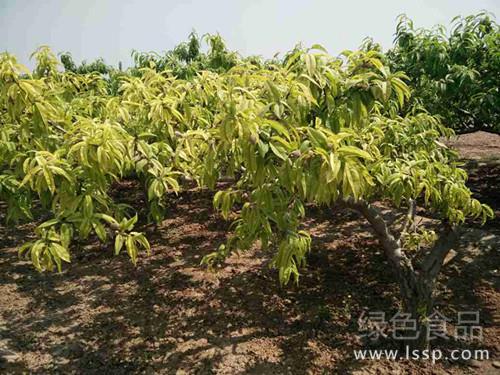
Yellow leaf disease of peach trees
1 Symptoms: Symptoms usually start from the leaves at the tips of new shoots of peach trees and gradually develop toward the base, appearing before the leaves have fully grown. In the early stage, the mesophyll turns yellow first, while the veins and the areas on both sides of them remain green, causing the leaf surface to appear as a green network. In the later stage, as the disease progresses, chlorosis worsens, the entire leaf turns white, the leaf margins scorch, and rust-brown necrotic spots or patches appear on the leaf margins and tips. The lateral veins of the leaves also turn yellow, the tips of new shoots die, and the middle and upper leaves drop early. In severe cases, tree vigor weakens, affecting flower bud quality, peach yield and quality, and as it progresses, it leads to the death of the entire tree.
2 Occurrence pattern and causes: The occurrence of this disease is related to factors such as iron deficiency or blocked iron uptake.
(1) Nutritional imbalance: Not applying organic fertilizer for many years while applying large amounts of chemical fertilizer, and excessive magnesium and manganese in the soil, lead to iron deficiency and cause yellow leaves. Attention should be paid to balanced fertilization.
(2) Soil salinization: In salinized soil, soluble ferrous iron converts to ferric iron, which is not easily absorbed by the tree, causing iron deficiency in peach trees, such as in calcareous soil, alkaline soil, and alkaline water; drought weather, water evaporation, and salts rising to the soil surface; low-lying land, high groundwater level, and salts accumulating on the surface. All factors that worsen the degree of soil salinization can cause this disease.
(3) Soil oxygen deficiency: Such as heavy clay soil, poor drainage, high soil moisture, and low application of organic fertilizer. Any factor affecting soil permeability may worsen the occurrence of this disease.
(4) Improper fertilization: Because peach tree roots are relatively sensitive to external factors, applying undecomposed human and animal manure and urine, overapplying nitrogen fertilizer, or applying chlorine-containing fertilizers or municipal waste compost can all damage the roots, affect root absorption of nutrients, and cause yellow leaves.
(5) Improper pruning: For young vigorous trees, failure to pay attention to summer pruning and regulation leads to orchard crowding and poor ventilation, causing yellow leaves. Conversely, excessively heavy renewal pruning can also cause leaf chlorosis.
(6) Inadequate pest and disease control: Untimely and incomplete pest and disease control can weaken tree vigor and worsen the disease, especially root rot, crown gall, gummosis, and peach red-necked longhorn beetle, which affect the growth and development of peach trees and cause yellow leaves.
(7) Other causes: Planting peach varieties susceptible to yellow leaf disease; planting peach seedlings carrying pests and diseases; failing to avoid the original planting site and cultivating on the same spot.
3 Control measures:
(1) Improve the soil. In saline-alkali land, plant green manure, intercrop legumes, increase organic fertilizer application, dig ditches to drain alkali, and mix sand to improve clay soil.
(2) Supplement iron. Before bud break, about 1 m from the trunk, dig ditches 15 cm deep along the main branches. For each peach tree, dissolve 0.5—1 kg Guoguang Shitalv in 15—20 kg water, pour it into the ditch, and fill with soil after the water has seeped in; or mix it with organic fertilizer in autumn and apply 20—30 kg per mu. During the growing season, spray ferrous sulfate solution at 300 times on the leaves, once every 15—20 days, for a total of 3 sprays. Or spray 0.1%-0.2% chelated iron solution, once every 7 days, for a total of 3 sprays.
(3) Increase organic fertilizer application. Apply decomposed farmyard manure to increase soil permeability, improve soil physical and chemical properties, and increase organic matter content. Farmyard manure is mostly acidic and can improve alkaline soil. In September-October, apply 5000 kg per mu. The use of chlorine fertilizers and waste compost is prohibited, and water should be applied after fertilization. From after flowering to the hard pit stage, do not water too frequently; if it is not very dry, watering may be omitted, and excessively vigorous trees after flowering should not be watered.
Loosening the soil around peach trees
(4) Do a good job of cultivating and loosening the soil. To increase soil permeability, carry out intertillage and soil loosening well, and loosen the soil after each watering. Especially in the rainy season or during waterlogging, drain promptly, and at the same time use the method of breaking soil without moving it to increase soil permeability.
(5) Open the light path and increase tree canopy permeability. Especially for young vigorous trees, carry out summer pruning and regulation in a timely manner, open the light path, avoid crowding, and ensure good ventilation and light penetration.
(6) Do a good job of pest and disease control. Give priority to prevention and combine it with control, and control pests and diseases in a timely manner, especially the red-necked longhorn beetle. Once it bores into the trunk, dichlorvos or aluminum phosphide can be used for fumigation. Specific method: wrap the tablet in cloth, place it into the insect hole, then add water, and cover with soil so gas does not escape; or add water to pyrethroid insecticides, then inject them into the hole with a syringe, and seal the opening with mud.
(7) Choose disease-resistant varieties. Such as Honggangshan, Tianwangtao, Bayuecui, Zhonghuataowang, etc.; avoid continuous cropping and ensure strict quarantine.